
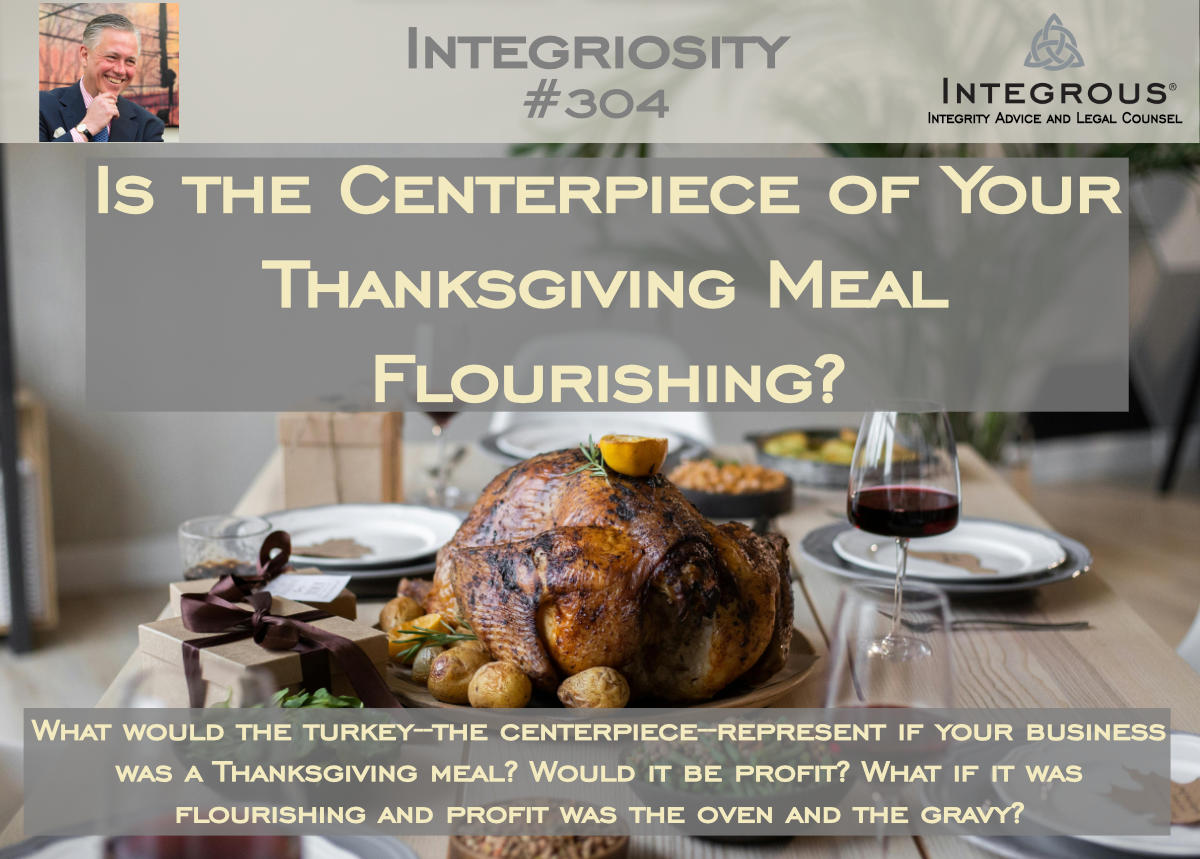
26 Nov #304 – Is the Centerpiece of Your Thanksgiving Meal Flourishing?
Turkey on Thanksgiving is a tradition because it serves as a cherished reminder of a uniquely American celebration. Turkey may appear on tables in many countries, gratitude is certainly universal, but Thanksgiving a distinctly American–a yearly November moment pointing back to what we have long imagined was enjoyed at the 1621 celebration in Plymouth, MA.
We decided to make our “Turkey/Profit” reflections a tradition as well, updating them each season. We hope you see this post as a “cherished reminder” in the same spirit. Like turkey itself, it has become one of our favorites.
Turkey is the centerpiece of the table, and unless your turkey has a radical commitment to sacrificial generosity, it is safe to say it would not describe itself as “flourishing” on your Thanksgiving table. So, what are we getting at?
This may sound odd (because it is), but as we thought about everything that goes into a traditional Thanksgiving meal, we began wondering: What would the turkey represent if your Thanksgiving celebration were a business?
Our conclusion is that the turkey–the centerpiece–is usually profit, but it shouldn’t be. Profit should be the oven (or the smoker or deep fryer) and the gravy. The true centerpiece should be Biblical flourishing. And in a new twist this year, we also explore why even the most faithful mashed potatoes are not enough.
Refresher: The Pursuit of Biblical Flourishing
Jonathan Pennington wrote, “Human flourishing alone is the idea that encompasses all human activity and goals . . ..”
We devoted post #200 to the prioritization of Biblical Flourishing. Biblical flourishing, as we have taught throughout our posts, is rooted in the Creation Mandate, Imago Dei, the Golden Rule, and the commandments to love God and neighbor.
Hopefully you recall the Creation Mandate (the commandment about our purpose on earth) that we discussed at length in post #46 (Lessons from Creation-Why We Are Here). Here it is again from Genesis 1:28:
And God blessed them. And God said to them, “Be fruitful and multiply and fill the earth and subdue it, and have dominion over the fish of the sea and over the birds of the heavens and over every living thing that moves on the earth.”
Theologians broadly agree that “subdue” and “dominion” point toward stewardship—our calling to care for God’s creation as its stewards.
We believe faithful stewardship of an organization must take into account four principles–Respect, Sustainability, Mutuality and Generosity:
• Respect. Respect for all humans as image-bearers of God, treating every stakeholder (owners, employees, vendors, customers, communities) with dignity and caring deeply about how the organization affects their flourishing.
• Sustainability. Sustainability across all aspects of a business, including its utilization of all forms of capital that drive the business and its relationships with the stakeholders related to those forms of capital. We have frequently quoted Jeff van Duzer’s book Why Business Matters to God (And What Still Needs To Be Fixed), and its insights on the breadth of sustainability are worth quoting: “Sustainability, however, can be understood in a much broader sense as well. As a business pursues its purposes, it must do so in a way that is sustainable across all of the dimensions of its interactions with its stakeholders.” This requires leaders to continually assess the health, availability, and responsible use of every form of capital—natural, human, social, and financial.
• Mutuality. Mutuality means extending a culture of Shalom to all people the organization touches—managing capital through Biblical lenses of community, relationship, dignity, and the common good. It ensures fairness in transactions regardless of bargaining leverage and embodies the Golden Rule, helping safeguard long-term relational and organizational sustainability.
• Generosity. As explained in post #189 (First Things–Righteousness), faithful integrity requires more than “giving generously”; it requires the “vertical integration” of generosity by living generously. Living generously means operating the organization—and generating wealth—in ways that sacrificially love others and steward creation. It involves choosing to forego benefits for the sake of the common good. Generosity naturally pairs with mutuality, as treating stakeholders more fairly than the world requires is itself an act of sacrificial, faithful stewardship.
Humans experience Biblical flourishing more fully–they are more “fully human”–when living in alignment with God’s design, which includes working in alignment with God’s design. That means they are more “fully human” when working in alignment with the Creation Mandate, Imago Dei, the Golden Rule, and the commandments to love God and love our neighbor.
Remember, an organization is simply a group of people working together toward a common goal. If people are created and called to live out the Creation Mandate, Imago Dei, the Golden Rule, and the commandments to love God and love our neighbor, then an organization aligned with Biblical flourishing must exist to do the same, and must therefore be managed in ways that encourage—rather than hinder—people in living out that divine calling.
Refresher: Profit Is Not Bad
Profit is NOT bad, and the creation by business of economic prosperity is good, because it enables families and communities to flourish. That bears repeating–PROFIT IS NOT BAD! In fact, we believe PROFIT IS NECESSARY for an organization (other than a non-profit organization) to be obedient to the Creation Mandate, which in turn means it is necessary for business in alignment with Biblical beliefs, principles and priorities, which in turn means it is necessary for the pursuit of Biblical flourishing through faithful integrity.
Profit in a business is necessary for each of the key elements of faithful stewardship.
• Respect. Business a better way does not ignore owners. A business that seeks to maximize Biblical flourishing must do so for all its stakeholders—including its owners. Owners are called to steward the capital entrusted to them, and profit enables them to flourish through a fair return. Anything less disrespects their stewardship responsibility and falls short of faithful leadership.
• Sustainability. Without profit, a business loses access to financial capital—one of the four essential forms of capital it requires. A lack of profit or access to financial capital threatens sustainability, and that is poor stewardship.
• Mutuality and Generosity. If a business cannot respect its owners or secure financial stability, it is unlikely to practice Mutuality or Generosity. Instead, it will resort to survival tactics (e.g., paying as little and as late as possible) while hoping others treat it fairly or even generously.
Human flourishing alone is the idea that encompasses all human activity and goals . . .. (Jonathan Pennington)
Your Centerpiece at Thanksgiving
Again, we think the centerpiece of Thanksgiving is the turkey. Yes, some of you may cast your vote for stuffing, potatoes, or pie, but Norman Rockwell’s iconic Saturday Evening Post cover from March 6, 1943, “Freedom from Want”–confirms what most people recognize—it’s all about the turkey.
Your Turkey as Profit – Business as Usual: Profit is not bad just like money is not the root of all evil. It is the love of money that the Bible tells us is the root of all evil. Like money, profit becomes bad when it moves from being a tool to being an idol. If anything is the “idol” of the Thanksgiving table, it’s the turkey. But your turkey—your centerpiece—should never be profit.
Perhaps the most consistent theme over the last 303 posts is that profit becomes a problem when it becomes the purpose of a business. We call it Profit as Purpose, and it is a hallmark of business as usual–business according to the world’s beliefs, values and priorities. If a Thanksgiving table represented business as usual, the turkey would be profit.
Back in post #171 (How the World’s “Way” Wrecks “Work”), we explained the key problems created by Profit as Purpose that contribute to the brokenness of business as usual.
Profit as Purpose is the idea that the primary or sole purpose of a business is the maximization of financial profit for the benefit of shareholders. As we explained in post #169 (The “Way” of the World), it is often referred to as the “shareholder primacy” model, and it has been predominant for the last several decades in America.
If your turkey is profit–the focus of the painting, the centerpiece of the table and the end toward which a business is managed:
• People and the rest of creation can never be more than tools of production to be managed toward that end (“No one can serve two masters“, Matthew 6:24).
• People will be valued based on their perceived profit contribution, often reduced to short-term financial metrics or stock performance.
• Decisions will be made mainly based on financial metrics, since they most directly measure profit and are easily quantified.
• Because an organization manages to its purpose, a key role of the organizational culture will be to drive profit. That culture—whether intentionally designed or allowed to emerge—often relies on manipulative mechanisms (e.g., fear of job loss, pressure-driven incentives, performance-anxiety tactics) to push people toward ever-increasing contribution to profitability.
Profit as the turkey works against faithfully stewarding people and the rest of creation toward Biblical flourishing, which means it works against the Creation Mandate.
In describing the role of profit in an organization, leaders sometimes characterize the role and priority of profit in ways that sound good but are not in line with Biblical principles or reality. In post #059 (Love-What About Profit?), we explained why profit can’t be one of several “ends” (i.e., “Look, we are not all about the turkey–we have stuffing and mashed potatoes and brussel sprouts“) and why Profit as Purpose can’t be transformed into a bigger WHY. Like a person, an organization can have only one ultimate ambition–one ultimate identity–one true “heart”. Without intentional leadership, that heart will be business as usual and profit over people and profit as the turkey.
Your Turkey as Flourishing – Business a Better Way: You may be getting tired of the Thanksgiving analogy but stay with us through a few “leftovers”—they matter.
Business a better way requires changing the heart of the organization by putting profit in its proper place as a means rather than an ultimate purpose. The Bible offers the ultimate WHY for our work and for business, because it is the ultimate WHY for all we do.
We are called to use our gifts to “serve one another” in a way that glorifies God (1 Peter 4:10-11). Ken Eldred captured this beautifully:
Profit is like oxygen. You absolutely need it to win the race. But that’s not the objective. The primary objective of business is serving others to the glory of God.
As we explained in post #101 (God Glorified), a business glorifies God principally through lovingly and generously serving people and stewarding all creation:
(1) providing jobs that allow people to experience Biblical flourishing by fulfilling their humanity and purpose in living out Imago Dei, the Creation Mandate, the Golden Rule, and the commandments to love God and love each other through service,
(2) providing economic prosperity, goods and services, and by solving problems and “repairing” the world, in ways that enable families, communities and creation to flourish, and
(3) creating a culture of Shalom built on Biblical principles of relationships, community and human dignity that is conducive to the flourishing of all people it touches.
This is Biblical flourishing as the turkey.
Where Does Profit Fit in at Thanksgiving?
Pushing our Thanksgiving analogy just a bit further, we believe profit is the oven and it’s the gravy.
The Oven. In the words of David Packard, co-founder of Hewlett Packard, “Profit is not the proper end and aim of management–it is what makes all of the proper ends and aims possible.”
This is profit as the heat source that cooks the turkey–whether you are a roaster, smoker or fryer. Unless you cook the turkey, Thanksgiving will be a bust. If you are hosting Thanksgiving, the heat source is essential to stewarding that responsibility well. While expressing the proper role of profit, Packard reportedly also made clear its importance–“anyone who cannot accept [profit] as one of the most important [objectives] of this company has no place either now or in the future on the management team of this company.”
The Gravy. If a business serves its employees, customers, vendors and community in a way that glorifies God by maximizing Biblical flourishing, profit is also likely to become the gravy–a by-product of a turkey cooked and served with love. When a business Humanizes people and Beautifies the world such that its employees, customers, vendors and communities flourish, it is likely that the business bringing about that flourishing will itself flourish. It aligns with the promises in Matthew 6:33 and Jeremiah 29:7:
But seek first the kingdom of God and his righteousness and all these things will be added to you. (Matthew 6:33)
But seek the welfare of the city where I have sent you into exile, and pray to the Lord on its behalf, for in its welfare you will find your welfare. (Jeremiah 29:7)
It is important to note that profit as gravy is not the same as the Side Road of Prosperitizing described in post #181 (The “Side Road” Detours of “Faith as Usual”). Prosperitizing is when a leader integrates faith and business in order to get God’s blessings in the form of increased profits. In Prosperitizing, cooking the turkey (caring for people) is really all about getting the gravy (profit).
If you have been following our posts, you will recall we spent 26 posts (#039-#064) on the principle of Keeping First Things First. Profit as gravy must be a second thing. Glorifying God through the maximization of Biblical flourishing must be a first thing. It was C.S. Lewis who wrote:
Put first things first and we get second things thrown in: put second things first and we lose both first and second things.
Can Awesome Mashed Potatoes Be Enough?
Last year we hinted at adding a mashed potato analogy–here it is. It may push the analogy close to (or even beyond) its limits, but it’s an important distinction.
Making the “turkey” of your business Biblical flourishing rather than profit is radical. Really doing it requires radical trust and radical dependence. It requires crossing the Safety/Surrender Gap. And because “surrender” appears to be quite rare among people of Biblical faith (estimated at 2% or less by George Barna in Maximum Faith), many Thanksgiving tables—many organizations—are led by people who have crossed the Sacred/Secular Gap but not yet the far more difficult Safety/Surrender Gap.
The result is often a table filled with awesomely faithful mashed potatoes—wonderful spiritual practices, admirable culture-building, generous programs—sitting right next to a profit turkey. But faithful mashed potatoes alongside a profit turkey still leave profit in the centerpiece position. It is what we analyzed in post #248 (Crossing the Fourth Gap) as the difference between what we are calling religious and faithful stewardship.
Religious Stewardship. Religious stewardship is sometimes expressed through phrases like “Do well while doing good” or “Profit with Purpose“. It incorporates faith activities into work and makes positive cultural improvements, but it stops short of true heart transformation. It sits on the “safety” side of the Safety/Surrender Gap and is still operating in the will of the faithful leader.
Faithful Stewardship. By contrast, the stewardship of surrender–“faithful stewardship” –means leading the organization in line with God’s will, which includes aligning its purpose, values and culture with Biblical beliefs, principles and priorities and transforming its WHY–its heart–from what the world values to what God values. It is genuine surrender. Faithful stewardship demands more than a “be a good Christian at work” approach; it requires offering the organization itself to God’s will.
Why Mashed Potatoes Are Not Enough. Religious stewardship is awesome mashed potatoes with a profit turkey. Those mashed potatoes often appear as the Side Road detours of faith as usual, substituting a lesser “good” for the “best”—true transformation of the organization’s heart and purpose. Religious stewardship is not “bad”. Engaging in the unquestionably good faith activities along the faith as usual Side Roads is “good”. But mashed potatoes are not the centerpiece and will not lead to the Biblical flourishing that most Glorifies God through Humanizing People and Beautifying the World.
As you gather around your table this Thanksgiving, it may be worth pausing to ask a simple question: What is the true centerpiece of the organization you lead? Is it profit—good, necessary, but never meant to occupy the place of ultimate purpose? Or is it Biblical flourishing—the fully human, God-honoring life that work and business were designed to enable?
This Thanksgiving, may your turkey be flourishing. May your profit be an oven hot enough to do its job and gravy plentiful enough to bathe your turkey and mashed potatoes, without ever becoming the point of the meal. And may your mashed potatoes—your good and faithful practices—not distract you from the centerpiece God intends: a business with the bigger WHY of Glorifying God by Humanizing People and Beautifying the World.
Wishing you a blessed Thanksgiving.
PERSONAL NOTE (from PM): This Thanksgiving, I am thankful for Genesis 9:3–God’s gracious expansion of the holiday menu beyond mashed potatoes and even brussel sprouts: “Every moving thing that lives shall be food for you. And as I gave you the green plants, I give you everything“?
ESSENCE: We are continuing our Thanksgiving tradition of “Turkey/Profit” reflections (with a new mashed potatoes twist this year). What would the turkey–the centerpiece–represent if your Thanksgiving celebration were a business? Our conclusion: the turkey is usually profit, but it shouldn’t be. Profit should be the oven (or the smoker or deep fryer) and the gravy. The true centerpiece should be Biblical flourishing. Business a better way requires changing the heart of the organization by putting profit in its proper place–as a means rather than the star of the show. That re-orients profit as the heat source that cooks the turkey: absolutely necessary but not the focus. Profit is NOT bad, the creation by business of economic prosperity is good, and profit in a business is necessary for good stewardship of the business, which means it is necessary for the pursuit of Biblical flourishing. When a business prioritizes glorifying God by lovingly serving its employees, customers, vendors and community in ways that allows them to experience Biblical flourishing, profit can also become the gravy–a by-product of a turkey cooked and served with love. Because making the “turkey” of your business Biblical flourishing rather than profit is so radical, many leaders settle for a faith as usual Side Road. The result is a table full of awesomely faithful mashed potatoes—wonderful spiritual practices, admirable culture-building, generous programs—sitting right next to a profit turkey. It substitutes a “good” for God’s “best”: true transformation of the organization’s heart and purpose through business a better way toward Biblical flourishing. P.S. We are thankful for you!
Copyright © 2024 Integrous LLC. Integriosity is a registered Service Mark of Integrous LLC.
Photo Credit: Original image by Monstera Production: https://www.pexels.com/photo/table-served-with-delectable-dishes-prepared-for-thanksgiving-dinner-5876784/ (photo cropped)
Sorry, the comment form is closed at this time.