

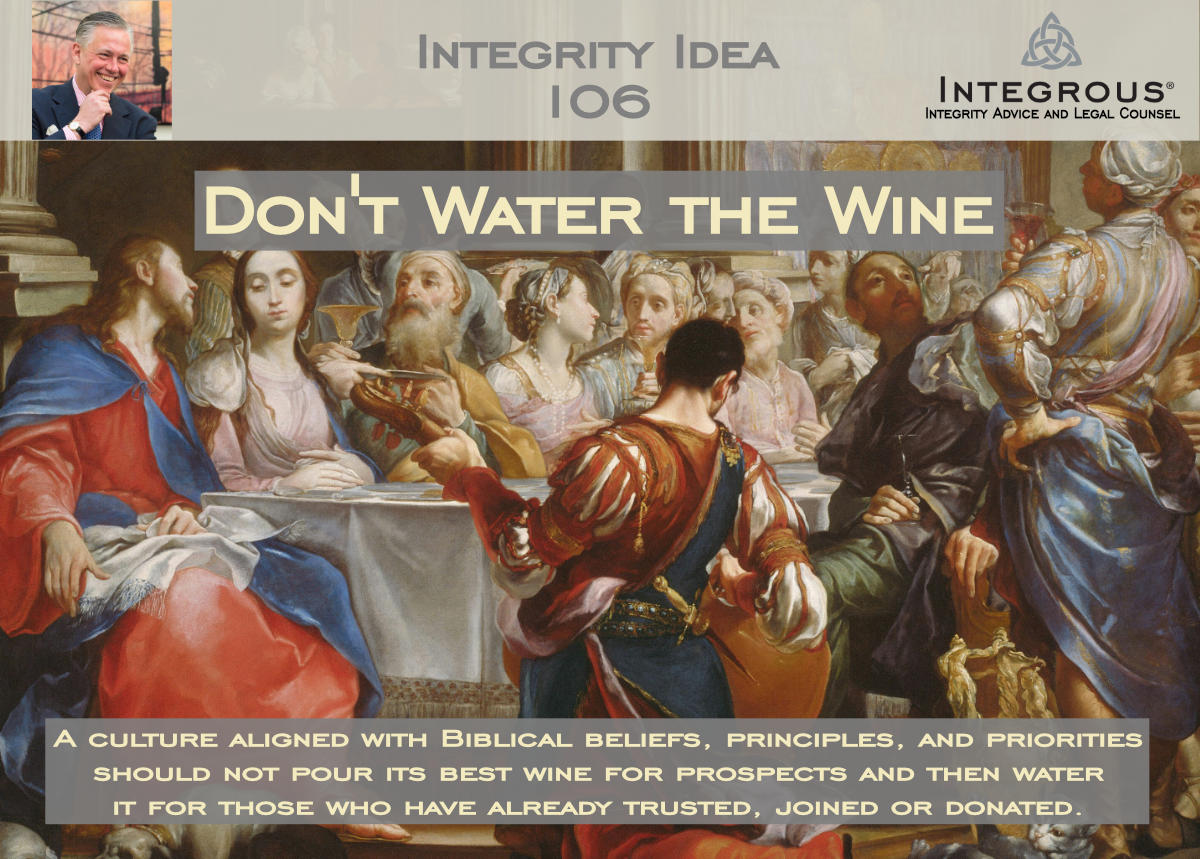
01 Jul #335 – Integrity Idea 106: Don’t Water the Wine
Integrity Ideas are specific actions a leader can consider during the Re-Align step of Integriosity®—actions that will begin to Re-Align the organization with Biblical beliefs, principles, and priorities. You can find more Integrity Ideas at Integrous | Integrity Ideas (integriosity.com)
INTEGRITY IDEA: Don’t Water the Wine
“Don’t Water the Wine” is about faithful leaders resisting the business as usual practice of giving the best pricing, attention, and service to new customers and clients while neglecting or taking for granted existing ones.
It recognizes that in the pursuit of faithful integrity through business a better way toward Biblical flourishing, the flourishing of all customers matters, including those who have already trusted, joined, bought, worked, served, donated, or stayed.
Integrity Ideas are practical actions toward implementing a bigger WHY for the organization. Some are helpful ideas to consider as a faithful leader prayerfully discerns the best stewardship of the organization. Others may be important steps in the RENEW/RE-ALIGN/RE-IMAGINE/RESTORE process.
“Don’t Water the Wine” is in the “important” category because it goes to the heart of the flourishing of customers and clients as well as to the integrity of an organizational culture that prioritizes relationships, community, human dignity, and flourishing.
In the famous Biblical story of the wedding at Cana, Jesus performed his first miracle by turning water into fine wine when the wedding wine ran out. The master of the feast was particularly impressed because it was better than what had been served earlier, turning on its head the custom of serving inferior wine once the guests were drunk.
“Don’t Water the Wine” recognizes that an organization aligning its culture with Biblical beliefs, principles, and priorities should not pour its best wine for prospects and then water it for those who have already trusted, joined, bought, worked, served, donated, or stayed.
All customers deserve to be treated with dignity and respect. The Golden Rule and the commandment to love your neighbor should be applied faithfully, whether a customer is merely prospective or already loyal.
While clear and transparent trial offers can be a legitimate form of invitation to encourage new customers, “Don’t Water the Wine” emphasizes the importance of not letting commitment become the moment when care begins to decline or loyalty becomes a reason to offer less rather than more.
It is important to distinguish “Don’t Water the Wine” from the Integrity Ideas suggested in post #194 (Integrity Idea 033: Provide Plain Pricing) and post #255 (Is Your Business in the Twilight Zone).
• In “Provide Plain Pricing,” our focus was providing customers with transparent and honest information about the price of the organization’s products and services. While “Don’t Water the Wine” is focused on how an organization cares for its existing customers, deceptive or manipulative pricing practices are usually aimed at attracting new customers or obscuring what customers will ultimately pay.
• In the Twilight Zone post, our focus was on business as usual practices of exploiting customers through “Can We” behavior—treating those supposedly being served as tools to be managed toward Profit as Purpose.
One area in which “Don’t Water the Wine” overlaps with the practices discouraged in those two posts involves pricing for existing customers. Some organizations quote a price to existing customers that far exceeds the price charged to new customers, but existing customers can receive the lower price if they are persistent enough (including threatening to cancel in many cases). Their calculation is that most customers will not be so persistent.
We believe this is, simultaneously, a dishonest, “Can We” practice that “waters the wine.” It is equivalent to the use of “unequal weights” decried in various passages in the Bible:
Unequal weights are an abomination to the Lord, and false scales are not good. (Proverbs 20:23)
“Don’t Water the Wine” does not require treating all customers the same. It calls for instituting practices to ensure that the treatment of existing customers reflects and reinforces an organizational culture that prioritizes relationships, community, human dignity, and flourishing.
CONTINUUM: Practices
The Integriosity model organizes “heart change” along six Covert-Overt Continuums. There is nothing inherently magic about these categories, but we believe they are helpful in thinking about practical execution of a Re-Imagined Purpose, Re-Imagined Values, and a Re-Imagined Culture. The Continuums are Prayer, Proclamation, Policies, Practices, Products, People.
Each Continuum represents an area in which leaders can begin to think about, plan, and institute Re-Alignment changes to the heart of the organization.
“Don’t Water the Wine” is on the Practices Continuum. It involves practices the organization can adopt to love and care for existing customers and clients.
COVERT-OVERT RATING: Highly Covert
The Integriosity model breaks the Covert-Overt Continuums into six gradations—from Highly Covert to Highly Overt—that we believe are helpful in beginning to pray and think about what is most appropriate for an organization at a particular moment in time.
Most Integrity Ideas have one place on the scale. Some can vary depending on how they are implemented. We identify “Don’t Water the Wine” as Highly Covert (an action that would be taken by a secular company), because every organization should be interested in caring for, and retaining, those who are already customers.
It can be moved toward the Overt end of the Continuum by, for example, being overt about the Biblical reasons for not following the business as usual practice of focusing resources on customer acquisition at the expense of customer care.
STAKEHOLDERS SERVED: Customers/Clients
When we categorize faith-based actions, we also consider the stakeholders principally impacted by the action: Employees, Customers/Clients, Owners, Suppliers/Vendors, Community and Kingdom.
“Don’t Water the Wine” principally serves Customers/Clients.
Caring at scale can’t be done by the CEO or a VP. But what these folks can do is create a culture that cares. (Seth Godin)
IMPLEMENTATION
Implementing “Don’t Water the Wine” will depend on the nature of the organization, its products and services, and its customers or clients. Ultimately it comes down to ensuring that all customers, whether prospective, new, or old, are cared for faithfully.
Caring for customers requires cultivating a culture in which employees understand that all customers are important—not just because they need to be acquired and retained but because they deserve to be treated with dignity and their flourishing is part of the mission of the organization. Seth Godin astutely observed:
Caring at scale can’t be done by the CEO or a VP. But what these folks can do is create a culture that cares. They can hire people who are predisposed to care. They can pay attention to the people who care and measure things that matter instead of chasing the short term.
Implementing “Don’t Water the Wine” requires an honest assessment of the “wine” being served to existing customers, as compared to the wine being served to entice new customers. Audit where your organization’s “best wine” is going. Compare how you treat people before they commit with how you treat them after they commit. Then look for places where loyalty, trust, or dependence has quietly become a reason to offer less rather than more.
Watered wine could appear in many different ways. For example:
• New customers get the best rates; loyal customers get renewal creep.
• The “sales” extension is answered promptly by a real person; the “customer support” extension goes to a bot or a voicemail black hole.
• Prospects get rapid responses; existing customers get slow support.
• Large customers get rapid responses; small customers get slow (or no) support.
• Large or prospective donors get attention during fundraising; long-time smaller supporters get taken for granted.
• Clients get senior attention during the pitch; then get handed off to juniors.
• Churches or ministries pour energy into attracting newcomers but neglect faithful members who keep showing up.
With the assessment in hand, it requires faithful leaders to prayerfully consider whether the wine being served to existing customers needs an upgrade, and if so, how existing customers can receive better care, be treated with more dignity, or be loved better in ways that glorify God.
“Don’t Water the Wine” is not about watering down the wine for prospective or large customers, and it does not require treating all customers the same.
• It is not inconsistent with having special treatment or volume pricing for very large customers; it does mean ensuring that the organization’s culture does not send a message to employees that small customers are unimportant.
• It does not mean that a business shouldn’t offer a discounted or free trial to encourage prospective customers to try their product or service, provided that the terms are honest and transparent; it does mean assessing the motives driving the organization’s pricing and ensuring that the organization’s pricing “culture” is not designed to take advantage of customer inertia or timidity.
It does mean cultivating a culture in which employees understand that the flourishing of every customer is important.
Ritz-Carlton hotels and Horst Schulze are famous for empowering every employee–including housekeepers–to spend up to $2,000/guest to solve a customer problem on the spot. While it is often cited as a way of treating employees with dignity, it is also a way ensuring that all customers are served “fine wine,” because it was not limited to those customers in the Presidential Suite or to those staying with Ritz for the first time. In his book Excellence Wins, Schulze emphasizes (emphasis in original):
Everyone, from the newest dishwasher on up, should know that their primary responsibility is to help keep the customer.
Shulze goes on to hold up the Rule of Saint Benedict as the model for comparison, “All guests who arrive should be received as if they were Christ.”
PERSONAL NOTE (from PM): I love to share a story told by Terry Wilcox, the former Executive Director of the Bridgeport Rescue Mission, that illustrates the importance of caring for all customers. The Mission’s development staff had a practice of personally thanking donors, no matter the size of the donation. It didn’t mean that big donors were treated the same as small donors, but even small donors were valued and recognized. One elderly donor had been faithfully making a $100 annual donation for many years. One year, when the development staff reached out to thank her, she asked if she could speak with someone about making a larger gift. Her next donation was $1,000,000.
ESSENCE: Integrity Ideas are specific practical actions a faithful leader can consider in leading faithfully through business a better way.
INTEGRITY IDEA: Don’t Water the Wine
In the famous Biblical story of the wedding at Cana, Jesus performed his first miracle by turning water into fine wine when the wedding wine ran out. The master of the feast was particularly impressed because it was better than what had been served earlier, turning on its head the custom of serving inferior wine once the guests were drunk. “Don’t Water the Wine” is about faithful leaders resisting the business as usual practice of giving the best pricing, attention, and service to new customers and clients while neglecting or taking for granted existing ones. It recognizes that an organization aligning its culture with Biblical beliefs, principles, and priorities should not pour its best wine for prospects and then water it for those who have already trusted, joined, bought, worked, served, donated, or stayed. In the pursuit of faithful integrity through business a better way toward Biblical flourishing, the flourishing of all customers matters. All customers deserve to be treated with dignity and respect. The Golden Rule and the commandment to love your neighbor should be applied faithfully, whether a customer is merely prospective or already loyal. While clear and transparent trial offers can be a legitimate form of invitation to encourage new customers, “Don’t Water the Wine” emphasizes the importance of not letting commitment become the moment when care begins to decline. It reflects and reinforces an organizational culture that prioritizes relationships, community, human dignity, and flourishing.
COVERT-OVERT CONTINUUM (six Continuums for action): Practices
COVERT-OVERT RATING (several levels from Highly Covert to Highly Overt): Highly Covert
STAKEHOLDERS SERVED: Customers/Clients
Copyright © 2026 Integrous LLC. Integriosity is a registered Service Mark of Integrous LLC.
Photo credit: Original image by Art Institute of Chicago on Unsplash
(photo cropped)
No Comments