

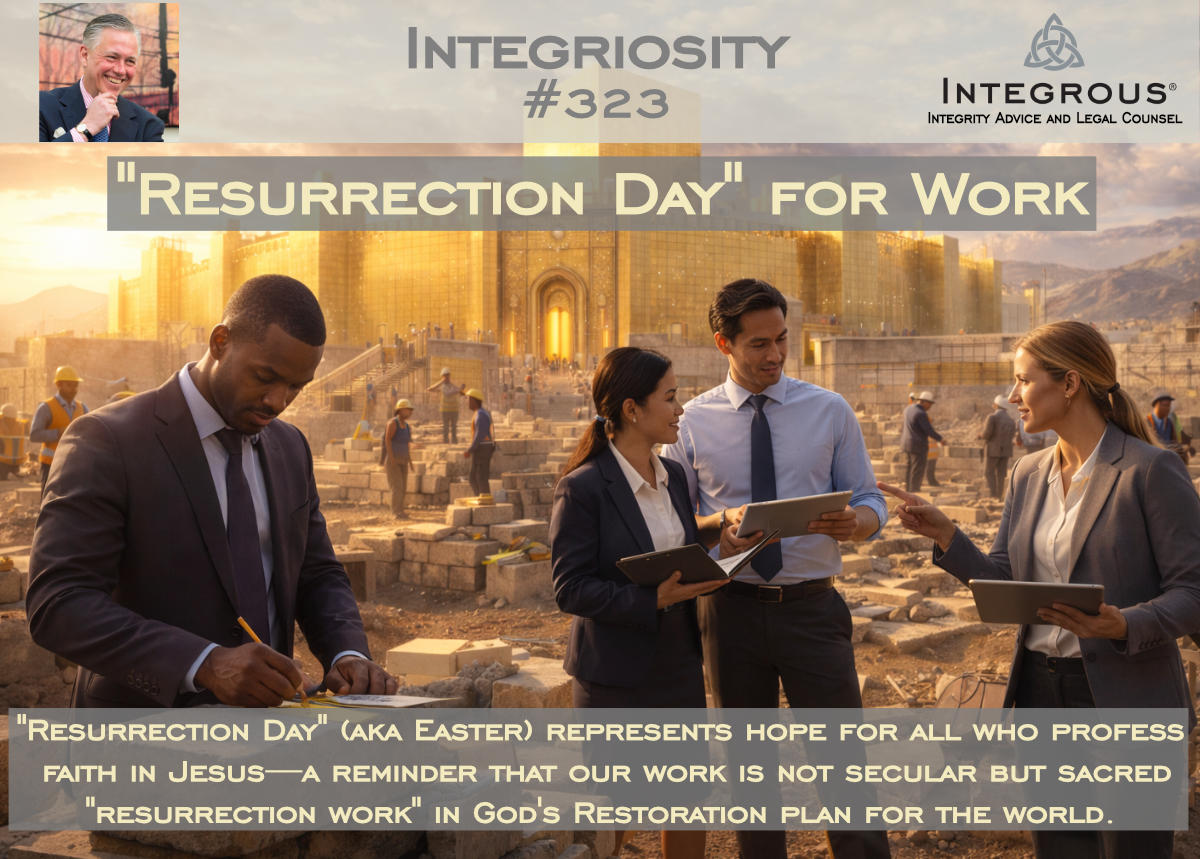
08 Apr #323 – “Resurrection Day” for Work
For followers of Jesus, Holy Week and its culmination in Easter (aka “Resurrection Day”) is a sacred tradition. It serves as a time to remember God’s greatest gift to his creation–the promise of forgiveness and eternal life through Jesus’s sacrifice. But Easter is not just a remembrance—it is a declaration that death has been defeated and new life has begun.
Anecdotally, it seems that more people began using the term “Resurrection Day” this year. It helpfully and meaningfully moves attention away from colored eggs, chocolates, and the Easter Bunny. More importantly, it makes us think about “resurrection living”. We’re going with it.
We believe Resurrection Day also has a hopeful message for those desperately seeking purpose through their work, business and investing. We first shared this hope back in post #117 and have decided to make these Resurrection Day/WHY thoughts from prior seasons a tradition, but with some updates. Hopefully, you see it as a worthwhile reminder.
It is obvious that the holiday of Easter is very important for some workers, businesses and investors. Consumers were expected to spend over $24 billion on Easter in 2026, continuing a steady upward trend from $22.4 billion in 2024 and $23.6 billion in 2025. Even people who don’t celebrate Easter are predicted to contribute meaningfully to this total.
What is not so obvious (but infinitely more important) is the importance of the reality and significance of Resurrection Day—i.e., the reality and significance of Jesus’s resurrection—for every worker, business and investor, particularly those who are, or which are led by, followers of Jesus. Not only is it a source of hope for us as individuals, it should be a source of hope for those seeking purpose in their work, business and investing.
With the miracle of Resurrection Day still fresh in our memory, there is no better time to prayerfully consider how the resurrection should shape a greater purpose—a bigger WHY—in how we work, how we lead businesses, and how we invest. In a culture that increasingly measures importance by spending, Resurrection Day quietly confronts us with a different question—not what our work gives us the means to consume, but its true purpose.
Understanding that purpose is the foundation for a subset of resurrection living—”resurrection working.” It is not a new category of work, but a new way of understanding all work, business, and investing.
BIGGER Gospel: A “Kingdom” Refresher
When we first wrote about the significance of Resurrection Day to work, business and investing back in 2022, our inspiration came from an N.T. Wright quote that was in a church bulletin on Resurrection Day:
Jesus’s resurrection is the beginning of God’s new project not to snatch people away from earth to heaven but to colonize earth with the life of heaven. That, after all, is what the Lord’s Prayer is about.
To understand the implications of Wright’s statement, we need to understand the Bible from a “Kingdom” perspective.
At Integrous, we believe that many faithful leaders and workers are operating out of a narrow and incomplete vision of God’s story. But it is not their fault. Many churches and religious leaders have presented (and continue to present) a Biblical message that truncates the narrative of the Bible. This difference is often referred to as a “Four-Part Gospel” (or a “Gospel of the Kingdom”) versus a “Two-Part Gospel” (or a “Gospel of Atonement”).
Four-Part Gospel (“Gospel of the Kingdom”). The grand Biblical narrative can be divided into four key parts (N.T. Wright adds an additional part, “Israel”, between Fall and Redemption, recognizing the importance of the Abrahamic covenant and God’s purpose for the Israelites):
(1) Creation;
(2) Fall;
(3) Redemption (through Jesus); and
(4) Restoration (of God’s Kingdom on earth)
Two-Part Gospel (“Gospel of Atonement”). Many churches and religious leaders have emphasized the middle two parts of the Biblical narrative in presenting “the Gospel”: (2) Fall and (3) Redemption (through Jesus). At the risk of oversimplification, this is presented as some variation of “You are a sinner, and Jesus came to save you.”
Dallas Willard identifies two forms of what he calls a “Gospel of Sin Management” (and we are calling a “Two-Part Gospel”): a Gospel of the right (correct beliefs) which emphasizes Evangelism and a Gospel of the left (correct actions) which emphasizes a Social Gospel of serving the underserved.
A Two-Part Gospel is “good” but not enough to explain the intrinsic value of work (and business and investing) in God’s Kingdom. A Two-Part Gospel makes it hard to see how work (or business or investing) can matter to God unless it is explicitly evangelistic or is helping the underserved (or is generating wealth that is used to support those evangelizing or helping the underserved).
The bigger problem with a narrow Gospel is that if you don’t know where you came from or where you are going, it is hard to make sense of where you are and what you should be doing!
By including Creation, a Four-Part Gospel tells WHY we are here, HOW we were made, and WHAT work (and business and investing) and relationships represent in God’s design. By including God’s Restoration plan for His Kingdom on earth, a Four-Part Gospel tells the whole story of WHY Jesus redeemed us (beyond salvation), WHAT we are supposed to do after being redeemed and HOW work (and business and investing) is relevant in God’s Kingdom plan.
Restoration: A “Where We Are Going” Refresher
The nature of “heaven” and what happens to us and our world when Jesus returns may be theologically controversial topics, but they are also important ones. They are important because our understanding of “where we are going someday” profoundly affects “how we act today”.
There are basically two Biblical views of heaven and what happens to earth (we don’t need to get into theological debates regarding: whether there is a hell; if there is a hell, who goes there and who goes to heaven; and if there is a hell, whether it is eternal):
Rapture. People going to heaven are whisked off to an ethereal heaven and the earth burns up.
Restoration. Heaven is here on earth in a restored Kingdom that unites God’s dimension with our earthly dimension.
We highly recommend N.T. Wright’s book Surprised by Hope: Rethinking Heaven, the Resurrection, and the Mission of the Church for a discussion of the two views of heaven, their genesis, as well as an explanation of what we actually learn from the Bible. Here are a few excerpts:
Traditionally, of course, we suppose that Christianity teaches about a heaven above, to which the saved or blessed go, and a hell below, for the wicked and impenitent.
It comes as something of a shock, in fact, when people are told what is in fact the case: that there is very little in the Bible about “going to heaven when you die” and not a lot about a postmortem hell either. The medieval pictures of heaven and hell, boosted though not created by Dante’s classic work, have exercised a huge influence on Western Christian imagination.
But the language of heaven in the New Testament doesn’t work that way. “God’s kingdom” in the preaching of Jesus refers not to postmortem destiny, not to our escape from this world into another one, but to God’s sovereign rule coming “on earth as it is in heaven.”
Heaven, in the Bible, is not a future destiny but the other, hidden, dimension of our ordinary life—God’s dimension, if you like. God made heaven and earth; at the last he will remake both and join them together forever.
Now, let’s consider how these two views of heaven impact how we act today:
Rapture. If people going to heaven are whisked off to an ethereal heaven and the earth burns up, what we do on earth doesn’t matter much in the long run (assuming you believe in salvation by faith rather than by works)—it is all going away and, ultimately, our efforts to improve the world are in vain. What we do on earth mainly matters to the extent it encourages (or discourages) people to turn toward God or reflects God’s compassion for the underserved (which hopefully also encourages them to turn toward God).
Restoration. If heaven is here on earth in a restored Kingdom that unites God’s dimension with our earthly dimension, then things get exciting because what we do here may last into eternity. It means “resurrection living” and “resurrection working”—living and working with eternal purpose—are not possibilities, but callings.
Jesus's resurrection is the beginning of God's new project . . . . (N.T. Wright)
Why Resurrection Day Represents Hope for Work, Business, and Investing
Even if your work, business, and investing don’t involve candy, greeting cards or flowers, Resurrection Day represents hope. It is hope for every worker, businessperson, and investor who professes a faith in Jesus because it serves as a reminder of a bigger WHY for our work (and business and investing) rooted in God’s Restoration plan for His Kingdom.
As N.T. Wright proclaimed, the resurrection represents the beginning of God’s new project “to colonize earth with the life of heaven.” In a Trinity Forum Podcast, Wright described it as follows:
Something happened then [at the Resurrection] as a result of which the world is a different place. And we are summoned, not just to enjoy its benefits, but to take up our own vocations as new creation people, as spirit-filled and spirit-led Jesus followers bringing his kingdom into reality in our world.
Resurrection Day for “Rapturists”. If you are firmly planted in the Rapture camp, then Resurrection Day is extremely important for you individually. But it should also be relevant to your work (or business or investing) to the extent you are using it as a platform or vehicle to evangelize others. We can use our work (and business and investing) to tell people about Jesus and to provide a foretaste of heaven so that people are enticed into putting their faith in Jesus Christ.
Resurrection Day for “Restorationists”. Believing that Resurrection Day is the beginning of a project to bring heaven to earth in a restored Kingdom has huge implications for work, business and investing.
It means they are sacred activities, not only as platforms and vehicles for evangelism but as ways to beautify the world through:
• The way in which we work.
• The way in which we conduct business and lead organizations.
• The way in which we invest and the priorities and expectations we communicate as investors
• The products we create or capitalize that meet needs, provide solutions to the material challenges of human life, and “repair” the world.
• The economic prosperity that makes those products affordable and accessible in a way that cares for all creation and enables families and communities to flourish.
• The purpose, values, and culture that shape and guide our organizations and work activities.
Every decision has the potential to move God’s Kingdom a little closer to God’s perfect Restoration (or, sadly, a little further away). Work, business, and investing have intrinsic Kingdom value. This is “resurrection work.”
We believe the three bigger WHY’s of an organization operating with faithful integrity through business a better way toward Biblical flourishing are to Humanize People, Beautify the World and Glorify God. As a refresher:
• Humanize: An organization helps people become more “fully human” and flourish by engaging them in meaningful work that unleashes their God-given productivity and creativity and creates economic prosperity in a culture of Shalom built on Biblical principles of relationships, community, and human dignity.
• Beautify: An organization adds to the beauty of the world and assists in God’s restorative plan for His Kingdom by creating opportunities, economic prosperity, goods and services, and by meeting needs, solving problems and “repairing” the world, in ways that help families and communities to flourish and by extending its culture of Shalom to all people it touches. In the process, the work of the organization takes on deeper meaning for its own people.
• Glorify: An organization glorifies God and loves its neighbors principally through serving people–by providing opportunities for individuals to express aspects of their God-given identities in creative and meaningful work, by providing opportunities, economic prosperity, goods and services, and by solving problems and “repairing” the world, in ways that enable families and communities to flourish and by creating a culture of Shalom conducive to the flourishing of all people it touches.
The Restoration understanding of heaven we learn from Revelation gives forward-looking purpose to the underlying goodness and importance of work (and business and investing) we can only learn from Genesis. They are the bookends. We will end where we began, with a quote from N.T. Wright:
When Paul wrote his great resurrection chapter, 1 Corinthians 15, he didn’t end by saying, “So let’s celebrate the great future life that awaits us.” He ended by saying, “So get on with your work because you know that in the Lord it won’t go to waste.” When the final resurrection occurs, as the centerpiece of God’s new creation, we will discover that everything done in the present world in the power of Jesus’s own resurrection will be celebrated and included, appropriately transformed.
To once again borrow from the quote on a Resurrection Day church bulletin (from Easter 2023 at Talmadge Hill Community Church):
Easter declares that you can put truth in a grave but it won’t stay there. (Clarence W. Hall)
The world can push and pressure a faithful leader toward business as usual, and investors can demand that Profit as Purpose must be the end toward which a business is managed, but the truth is that God created work, and by extension business and investing, with a much bigger WHY–and Resurrection Day is a vivid reminder. That truth will not stay buried. It is meant to be lived—and it should be a source of hope and a new way to work. This is “resurrection work.” Rejoice–He is risen indeed!
PERSONAL NOTE (from PM): Readers of his blog know how often I look to the wisdom of N.T. Wright. I think this remains my favorite N.T. Wright passage:
What you do in the present—by painting, preaching, singing, sewing, praying, teaching, building hospitals, digging wells, campaigning for justice, writing poems, caring for the needy, loving your neighbor as yourself—will last into God’s future. These activities are not simply ways of making the present life a little less beastly, a little more bearable, until the day when we leave it behind altogether. They are part of what we may call building for God’s kingdom.
ESSENCE: Anecdotally, it seems that more people began using the term Resurrection Day this year instead of Easter. It helpfully and meaningfully moves attention away from colored eggs, chocolates, and the Easter Bunny. More importantly, it makes us think about “resurrection living,” which includes “resurrection working.” We’re going with it. Does Resurrection Day give you hope for the purpose of your work, business, and investing? It should be a source of hope for every worker, business leader, and investor who follows Jesus because it serves as a vivid reminder of a bigger WHY and a sacred relevance for our work, business, and investing rooted in God’s Restoration plan for His Kingdom. Believing that Resurrection Day is the beginning of a project to bring heaven to earth in a restored Kingdom has huge implications for the WHY of work (and business and investing). It gives forward-looking purpose and relevance to the underlying importance of work (and business and investing) we can only learn from Genesis—work (and, by extension, business and investing) was designed as a sacred activity not only as a platform and vehicle for evangelism or serving the underserved but as a way to beautify the world. It means every business and investment decision has the potential to move God’s Kingdom a little closer to God’s perfect Restoration. It means work, business, and investing have intrinsic Kingdom value, and the WHY and HOW of our work, business, and investing matter. This is “resurrection work.” Rejoice–He is risen indeed!
No Comments