
14 Jan #311 – Integrity Idea 092: Celebrate Lives
Integrity Ideas are specific actions a leader can consider during the Re-Align step of Integriosity®–actions that will begin to Re-Align the organization with Biblical beliefs, principles and priorities. You can find more Integrity Ideas at Integrous | Integrity Ideas (integriosity.com)
INTEGRITY IDEA: Celebrate Lives
“Celebrate Lives” is about a faithful leader implementing practices that intentionally remember, honor and celebrate members of the organization who have died.
Integrity Ideas are practical actions toward implementing a bigger WHY for the organization. We believe some are critical (and necessary) steps in the RENEW/RE-ALIGN/RE-IMAGINE/RESTORE process. Others are just ideas to be considered if they feel like a good fit based on what leaders prayerfully discern is best for stewarding the organization toward its WHY.
“Celebrate Lives” is in the “if it fits” category. That said, it can often be a simple and accessible way to demonstrate that employees are valued as human beings created in the image of God.
Celebrate Lives recognizes the Imago Dei in those departed–a dignity that does not end at death–as well as the importance of relationships built in the workplace. A service, ceremony, or other celebration provides an opportunity for employees to grieve and share stories.
“Celebrate Lives” serves as a reminder of the most important priority shift needed for an organization to pursue faithful integrity and align its culture with Biblical beliefs, principles, and priorities–prioritizing people over profit. It is a proclamation that the people who work together in the organization matter as humans and not merely as tools of production.
If families of the deceased are invited into the celebration, “Celebrate Lives” can also provide an opportunity for employees to live out the Golden Rule and the commandment to love your neighbor by sharing with those families the impact their loved ones had on the people with whom they worked.
The periodic or memorialized remembrance of those passed can be found in the entertainment industry, government service, the military, fraternal organizations, universities and hospitals. Here are just a few examples:
• Various entertainment award ceremonies such as the Academy Awards include an “In Memoriam” segment remembering prominent members of the industry who have died in the prior year.
• The Central Intelligence Agency has a memorial wall with 140 stars to remember those who gave their lives in service.
• There are numerous war memorials to honor veterans who lost their lives in service.
• Fraternal organizations often pause for a moment of silence for members who have died since their last meeting.
• The New Jersey DOT has a memorial wall to honor those who died in service.
• At Harvard College reunions, a memorial service is held at which the names of departed classmates are read.
• Texas A&M has an annual “Aggie Muster” tradition of a “Roll Call for the Absent”. On each April 21, alumni gather to read the names of all Aggies who died in the prior year, and those in attendance respond “Here” to signify that the departed are there in spirit.
• Johns Hopkins Kimmel Cancer Center holds a spiritual but nonsectarian “Service of Remembrance” to remember patients who have died.
Aside from bereavement policies and human resource practices of notifying employees and sending notes and flowers, it is much more difficult to find examples of “Celebrate Lives” in business organizations, but here are two inspiring examples–one from a large organization and one from a small one:
Toyota: Three Toyota plants in the United States intentionally honor and remember deceased employees through both a tangible reminder as well as a ceremony. Each facility maintains a Team Member Memorial Monument featuring an always-accessible garden memorial listing the names and years of service of team members who have passed away. Each plant also holds an annual Team Member Memorial Service to honor those who died during the prior year. The Plant President and executives attend and speak at the service, which is treated as a priority by the plant’s top leadership. Families of the deceased and those who worked closely with the team member are invited. It is a time to highlight the individual’s life and contribution in the workplace.
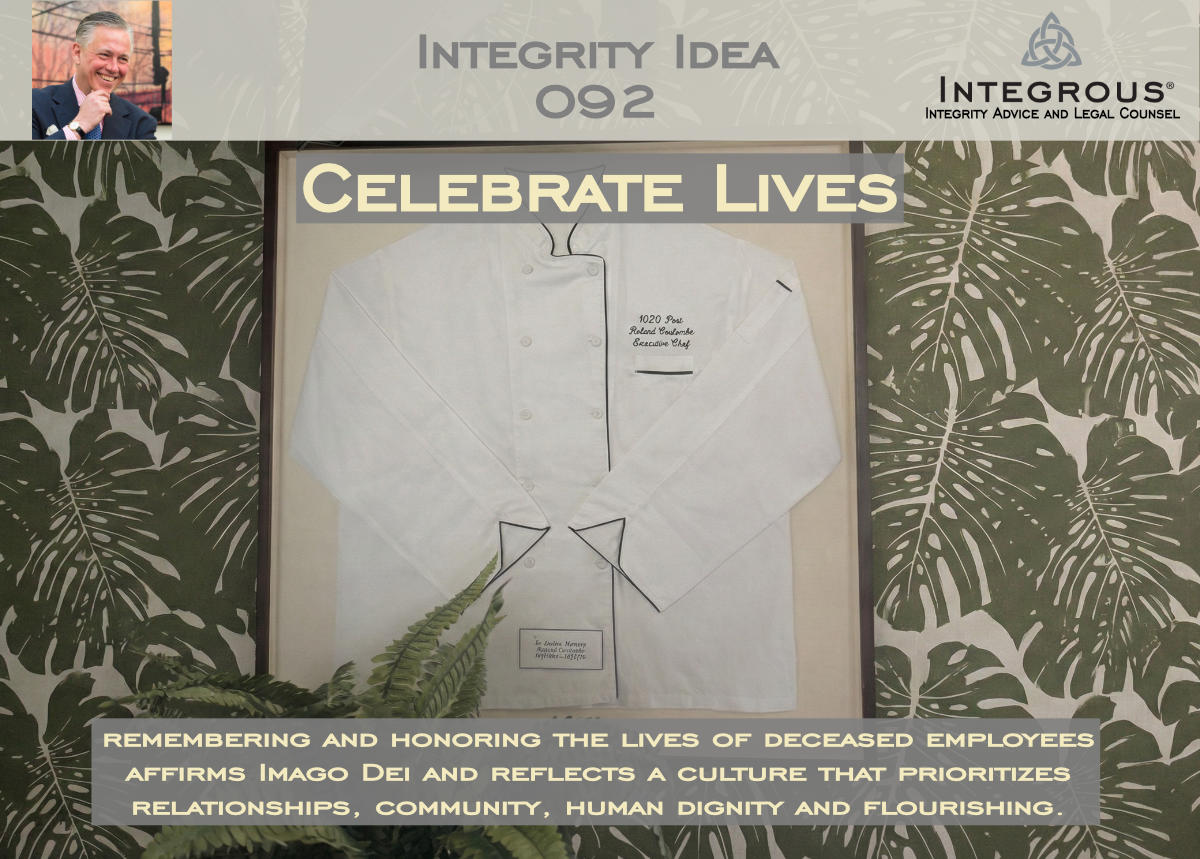
Ten Twenty Post Restaurant: The image used with this post is from Ten Twenty Post restaurant in Darien, CT. Following the sudden loss of its beloved chef, the owner framed his jacket and hung it in the restaurant to honor his memory. This simple act of remembrance communicates that a person’s contribution and presence do not disappear when their work ends.
As with all actions, WHY matters. “Celebrate Lives” must come from a heart for the colleague who has departed and for those who grieve the loss. It must not be motivated by an ulterior desire to impress, manipulate, or instrumentalize employees or to “look” compassionate to customers or the community. Implementing “Celebrate Lives” is an opportunity for a faithful leader to check their heart.
We believe a faithful leader seeking to lead with faithful integrity through business a better way toward Biblical flourishing should consider implementing “Celebrate Lives”. It reflects and reinforces a business a better way culture that prioritizes relationships, community, human dignity, and flourishing. If done with the right WHY–the right heart–it is humanizing for employees and the family of the departed, and it makes the world a bit more beautiful–moving it a bit closer to God’s design.
CONTINUUM: Practices
The Integriosity model organizes “heart change” along six Covert-Overt Continuums. There is nothing magic about these categories, but we believe they are helpful in thinking about practical execution of a Re-Imagined Purpose, Re-Imagined Values and a Re-Imagined Culture. The Continuums are Prayer, Proclamation, Policies, Practices, Products, People.
Each Continuum represents an area in which leaders can begin to think about, plan and institute Re-Alignment changes to the heart of the organization.
“Celebrate Lives” is on the Practices Continuum. It is a practice the organization can adopt to care for employees and to reflect and reinforce its purpose and values.
COVERT-OVERT RATING: Highly Covert
The Integriosity model breaks the Covert-Overt Continuums into six gradations–from Highly Covert to Highly Overt–that we believe are helpful in beginning to pray and think about what is most appropriate for an organization at a particular moment in time.
Most Integrity Ideas will have one place on the scale. Some can vary depending on how they are implemented. We identify “Celebrate Lives” as Highly Covert (An action that would be taken by a secular company) because every organization could and should strive to honor and remember deceased employees and care for current employees.
“Celebrate Lives” can also be Overt (An overtly faith-based action known generally within the organization) if the leaders of the organization choose to bring faith into the celebration or to explain its importance in terms of Imago Dei and Biblical basis for the organization prioritizing relationships, community, human dignity, and flourishing. It could even be Highly Overt (an overtly faith-based action involving community, website, sales/marketing materials) if people outside the organization are invited or if a tangible memorial is in a public space, observable by visitors.
STAKEHOLDERS SERVED: Employees, Community
When we categorize faith-based actions, we also consider the stakeholders principally impacted by the action: Employees, Customers/Clients, Owners, Suppliers/Vendors, Community and Kingdom.
“Celebrate Lives” principally serves Employees by providing an opportunity to grieve and by reinforcing that they matter as humans and not just as tools. It also serves the Community to the extent family of the deceased is invited to the celebration.
Every human person possesses an infinite dignity, inalienably grounded in his or her very being. (Vatican Declaration on Infinite Dignity)
IMPLEMENTATION
Implementing “Celebrate Lives” can be inexpensive and easy or it can be elaborate and costly. The most important thing is that it comes from a pure heart. It can be as simple as a moment of silence and as elaborate as a company-wide gathering with families and a permanent marker memorializing the employee.
Importantly, “Celebrate Lives” is not meant to substitute for other policies and practices designed to care for employees or the family of the deceased–practices such as sending flowers, sending condolence notes, providing grief counseling to employees, providing support for the family, or allowing employees personal time to attend a funeral. It is about honoring and remembering those who were part of the organization’s community.
The size and nature of the organization will have an impact on its implementation. A small organization hopefully doesn’t experience any deaths in a normal year; however a large manufacturing facility may, particularly if retirees are included.
For a faithful leader implementing “Celebrate Lives”, here are some options and questions to prayerfully consider.
• How often will lives be celebrated?
• At an annual event? A quarterly event?
• On an ad hoc basis after someone dies?
• How will lives be celebrated?
• A moment of silence?
• A reading of names with a group response such as “Here” or “We remember”?
• An opportunity for people to share their reflections publicly?
• A physical memorial such as an inscription on a memorial wall or garden or an engraved brick in a pavement?
• A virtual memorial such as inclusion on a special page on an intranet or company website?
• A donation to a charity in honor of the departed.
• Where will the lives be celebrated?
• At a special gathering or another regularly scheduled gathering?
• Virtually via video conference?
• Who will be invited?
• All employees? Only employees who worked closely with the deceased?
• Will family of the departed be invited?
• How faithfully overt will the celebration be? If it will be overt and the family is invited, we suggest ensuring that the family will not be uncomfortable or offended.
• How will the family be notified about the nature of the celebration? Will family consent be obtained?
There is no wrong approach to “Celebrate Lives” as long as it comes from a pure heart. It can’t be about looking good, motivating workers, or evangelizing people. It must be about celebrating the infinite and inherent dignity of the deceased as a wonderful and beautiful human creation in the image of a wonderful and beautiful God–a human creation who spent much of their time in service to the organization’s purpose and in relationship with the organization’s people. The Vatican’s Declaration on Infinite Dignity said it beautifully:
Every human person possesses an infinite dignity, inalienably grounded in his or her very being, which prevails in and beyond every circumstance, state, or situation the person may ever encounter.
PERSONAL NOTE (from PM): This post was originally inspired by hearing about the Toyota ceremonies and then prompted to action by the Chef’s jacket at Ten Twenty Post Restaurant in Darien, CT. It is the venue that has graciously and generously hosted morning gatherings of NCS New Canaan, the founding chapter of the New Canaan Society, since early 2009. It has been hanging there for years, and I have looked at it for years. This week God opened my eyes to what it represented.
My Dad worked as the plant manager in a factory that made car antennas. He had been there for decades. When he died, the funeral home had a line out the door of work colleagues who came to pay their respects for who he was as a human being. They shared stories that revealed a side of him I would have never seen or heard about if not for their generosity. They were stories of his kindness, compassion and grace. At its best, “Celebrate Lives” is about creating an opportunity for the sharing of such stories–an opportunity for spouses and children and parents and siblings to hear about how a life they loved touched other lives Monday through Friday. At its best, “Celebrate Lives” creates sacred space for stories that would otherwise be lost.
ESSENCE: Integrity Ideas are specific practical actions a faithful leader can consider in leading faithfully through business a better way.
INTEGRITY IDEA: Celebrate Lives
“Celebrate Lives” is about a faithful leader implementing practices that intentionally remember, honor, and celebrate members of the organization who have died. It recognizes the Imago Dei in those departed–dignity that does not end at death–as well as the importance of relationships built in the workplace. In doing so, it reflects and reinforces a business a better way culture that recognizes the Imago Dei in each person and prioritizes relationships, community, human dignity, and flourishing. “Celebrate Lives” serves as a reminder of the most important priority shift needed for an organization to pursue faithful integrity and align its culture with Biblical beliefs, principles, and priorities–prioritizing people over profit. It is a proclamation that the people who work together in the organization matter as humans and not merely as tools of production. If families of the deceased are invited into the celebration, “Celebrate Lives” can also provide an opportunity for employees to live out the Golden Rule and the commandment to love your neighbor by sharing with those families the impact their loved ones had on the people with whom they worked. If done with the right WHY–the right heart–”Celebrate Lives” is humanizing for employees and the family of the departed, and it makes the world a bit more beautiful–moving it a bit closer to God’s design.
COVERT-OVERT CONTINUUM (six Continuums for action): Practices
COVERT-OVERT RATING (several levels from Highly Covert to Highly Overt): Highly Covert
STAKEHOLDERS SERVED: Employees, Community
Copyright © 2026 Integrous LLC. Integriosity is a registered Service Mark of Integrous LLC.
Photo credit: Original image by Paul Michalski (photo cropped with enhancements by ChatGPT)
No Comments