
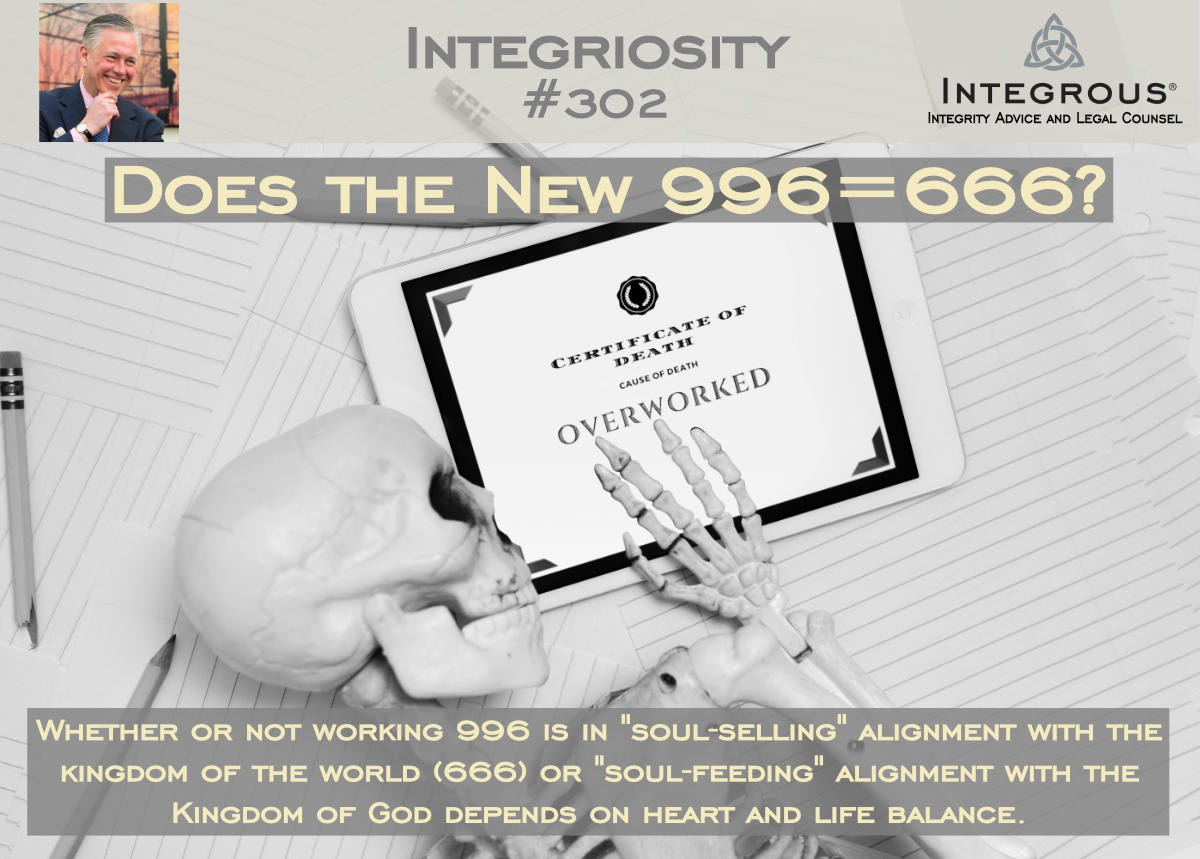
12 Nov #302 – Does the New 996 = 666?
Mathematically, 996 ≠ 666. Spiritually, they can be uncomfortably close–it doesn’t take much to flip two digits.
A recent article in Fast Company talked about a new “996” workweek that is “gaining momentum across the U.S., especially in certain industries.” Opening with the words, “So long, nine-to-five. There’s a new work schedule that’s taking over,” the article explains that 996 stands for a 9:00 AM–9:00 PM workday, six days per week—a 72-hour workweek. It’s a big shift from Dolly Parton’s “9 to 5”, but does it equate to “666”—in other words, is it aligned with the kingdom of the world and in opposition to the ways of the Kingdom of God?
We think the answer is “It depends.” Whether 996 equals “666” depends not on the clock but on the heart—on whether work is driven by the pursuit of worldly outcomes or ordered by faithful obedience—whether it equates to selling your soul or feeding your soul. Unfortunately, it is an “it depends” that falls heavily on the side of “soul selling”.
From 9-to-5 to 996: How We Got There and Here
The Road to 9-to-5. The eight-hour workday has its roots in the Industrial Revolution, the labor movement, and the Ford Motor Company. During the early Industrial Revolution, many laborers reportedly worked 10-16 hours a day. A slogan of the labor movement in the 19th century was coined by the British reformer Robert Owen:
Eight hours labour, eight hours recreation, eight hours rest.
This became a slogan of the American Federation of Labor (AFL) in the late 19th century as “Eight hours for work, eight hours for rest, eight hours for what we will.” There were even songs of the labor movement, such as the one below recorded by Pete Seeger.
But it was Henry Ford who established the 8-hour workday as a norm. Facing annual attrition of over 350% in its factories, Ford announced in 1914 it was adopting an 8-hour day for men (women followed in 1916). In 1926, Ford became one of the first American companies to adopt the five-day, 40-hour workweek for factory and office workers. Ford wrote:
We found that we could get at least as great production with three shifts of eight hours as with two shifts of nine hours. The men were fresher and more efficient, and the machines were kept running practically 24 hours a day.
Ford’s data and experience over 12 years indicated that reducing the workday from 10 to 8 hours and the workweek from 6 to 5 days increased total output.
The Road to 996. As we highlighted in post #164 (The Brokenness of “Business as Usual”), the book Profit with a Higher Purpose by Peet Van Biljon and James Sprouse does a good job highlighting the significant changes in the demands on workers in America over the last several decades leading to increased hours and greater stress (and the impact of those changes on health, marriages and children), including:
• The 40-hour work having broken down for various reasons they explain.
• U.S. workers taking less vacation than at any time in four decades.
• 37% of Americans sleeping less than 7 hours, mainly due to work and commuting.
Through its Office applications, Microsoft has a unique window into the state of the workplace. In its most recent Work Trend Index Annual Report, Microsoft reported:
• The average employee receives 117 e-mails and 153 Teams messages daily and sends or receives 50 messages outside core business hours each day.
• Meetings after 8:00pm are up 16%, 29% of workers are checking their inbox by 10:00pm, and 20% of workers check e-mails on the weekend.
The 996 workweek appears to have its roots in the Chinese tech industry, where several years ago it prompted a “nationwide debate about work culture and a rare protest against practices at some of the country’s largest companies”. Jack Ma, founder of Alibaba, is reported to have said:
If you join Alibaba, you should get ready to work 12 hours a day. Otherwise why did you come to Alibaba? We don’t need those who comfortably work eight hours.
A recent Wall Street Journal article titled “AI Workers Are Putting In 100-Hour Workweeks to Win the New Tech Arms Race” suggests that even 996 may be going the way of 9-to-5, with some employers putting the expectation of 80-hour workweeks in employment contracts. With work schedules approaching what one executive “jokingly” referred to as the “0-0-2” workweek (midnight to midnight with a two-hour break on weekends), a researcher at Google’s DeepMind is quoted as saying:
Everyone is working all the time, it’s extremely intense, and there doesn’t seem to be any kind of natural stopping point.
The Fast Company article notes that Elon Musk was asked about the optimal number of hours in a workweek and replied, “About 80 sustained, peaking above 100 at times. Pain level increases exponentially above 80.”
In fact, Ford’s observations about productivity have been confirmed by many scientific studies, and they do not align with Ma’s or Musk’s views. One study published in the Journal of Occupational Health in 2020 noted:
Numerous studies have been conducted by businesses, universities, industry associations, and the military. These studies support the basic notion that, for most people, 8 hours a day, 5 days per week, is the best sustainable long‐term balance point between output and exhaustion. Most workers are able to maintain consistent productivity when working for 40 hours per 5‐day workweek. However, ironically, productivity begins to decline with long working hours. A hundred years of industrial research has proven that longer hours at work do not increase output, except in the short term. Somewhere between a period of 4 days to 2 months, the gains from additional hours of work are diminished by the decline in hourly productivity.
Another recent Fast Company piece references surveys in which up to 82% of workers reported being at risk of burnout (with 69% in another survey saying the risk was moderate to high). As we detailed in post #237 (“Real” Culture Revisited), the Wall Street Journal published an expose in 2024 on young investment bankers being overworked—long hours even cited as a possible factor in one tragic death. The Chinese protests over 996 similarly included allegations of worker deaths due to overwork.
996 and the Bible
Setting aside 0-0-2 and refocusing on 996, the only concrete Biblical limitation on the length of the workweek is the Fourth Commandment. It was the focus of post #147 (Integrity Idea 015: Remember the Fourth). As we discussed in post #175 (Integrity Idea 025: Reward Rest), the Bible tells us about three key types of physical rest that God commanded–not simply suggested. There is Sabbath rest (rest every seventh day), Sabbatical rest (rest every seventh year) and “feast” rest (rest during several required feast periods).
But it is Sabbath rest that impacts the workweek, and we all know what God spoke to Moses about Sabbath rest in Exodus 20:8-11:
Remember the Sabbath day, to keep it holy. Six days you shall labor, and do all your work, but the seventh day is a Sabbath to the Lord your God. On it you shall not do any work, you, or your son, or your daughter, your male servant, or your female servant, or your livestock, or the sojourner who is within your gates. For in six days the Lord made heaven and earth, the sea, and all that is in them, and rested on the seventh day. Therefore the Lord blessed the Sabbath day and made it holy.
In his book 24/6: A Prescription for a Healthier, Happier Life, Dr. Matthew Sleeth observes that the Fourth Commandment is “the only commandment that begins with the word remember—almost as if God knew we would forget.”
In that respect at least, 996 does not violate the letter of God’s command, preserving one day of rest. But the Fourth Commandment is not the only thing the Bible has to say about our work. We know from Genesis that God enjoyed seeing the product of his work, and work was given to God’s image-bearers as a good thing. In many posts, we have shown that work is a way for humans to live out Imago Dei, and obey the Creation Mandate (i.e., “be fruitful and multiply“), the Golden Rule and the great commandment to love your neighbor. In other words, work in alignment with the Kingdom of God is meant to feed the soul.
Psalm 127:1-2 provides the most helpful Scriptural insight into whether 996=666.
It is in vain that you rise up early and go late to rest, eating the bread of anxious toil; for he gives sleep to his beloved.
Certainly, a 9-9 workday requires a person to “rise up early and go late to rest.” We believe the key to distinguishing “soul-selling” hard work in the way of the world from “soul-feeding” hard work in the way of the Kingdom of God lies in whether it is “in vain” and whether it is “anxious toil“.
So long, nine-to-five. There’s a new work schedule that’s taking over. (Sarah Bregel)
Whether 996=666 Depends on the Heart
We believe the answer to “Does 996=666?” depends on the heart–the heart of the employer and the heart of the employee. It gets back to what drives so much of the distinction between business as usual (and work as usual) and business a better way (and work a better way)–the WHY that motivates people’s behavior. “Soul-selling” or “soul-feeding”?
Back in post #125 (Choices: What’s Your “O”?), we said a life of faith is a life of choices, and one of those choices is whether the object of a faithful leader’s efforts is outcome or obedience. It is a choice between the kingdom of this world and the Kingdom of God. We think working 996 or expecting people to work 996 reflects the kingdom of this world if driven by outcome and the Kingdom of God if driven by obedience.
The “kingdom of this world” reflected in business as usual demands outcome. As we have emphasized over and over, a core attribute of business as usual is a WHY of Profit as Purpose. Business leaders have analysts, markets, and investors to keep happy. They have financial metrics to track and hurdles to achieve. The world of business as usual measures success in terms of profit and growth. It measures the value of work based on productivity. Leaders are expected to be ruthlessly “outcome driven.”
As explained in post #173 (The Toxicity of “Work as Usual”), business as usual creates a culture in which work as usual becomes all about “making money”, whether for survival or for power. When the culture of a business embodies the worldly outcome it is pursuing, people will come to understand, at some level, that they will be rewarded or punished based upon their perceived contribution to that goal–their productivity toward that goal. Work as usual will flow from business as usual, and they will begin to see co-workers as either competitors in a zero-sum game or primarily as tools for their success or survival in that culture.
Working long hours from a heart driven by money, power, success or fear, is “anxious toil“. Working long hours for the treasures the world values is work done “in vain.” Scripture warns:
But those who desire to be rich fall into temptation, into a snare, into many senseless and harmful desires that plunge people into ruin and destruction. (1 Timothy 6:9)
On the other hand, hard work done from a heart of obedience to a call of God is neither “in vain” nor “anxious toil“. 1 Corinthians 15:58 declares:
Therefore, my beloved brothers, be steadfast, immovable, always abounding in the work of the Lord, knowing that in the Lord your labor is not in vain.
Work done from a heart of obedience is done to serve God–“Whatever you do, work heartily, as for the Lord and not for men.” (Colossians 3:23)–not slavery to profit, corporate ambition, or productivity. Work done from a heart of obedience uses gifts to serve others to glorify God–“As each has received a gift, use it to serve one another, as good stewards of God’s varied grace…in order that in everything God may be glorified through Jesus Christ.” (1 Peter 4:10-11)
The Hebrew phrase “bread of anxious toil” (lechem ha‘atsavim) evokes Genesis 3’s painful labor; the contrast is God’s Psalm 127 gift of sleep—trust over grind.
Hebrew scholar Dr. Skip Moen captures the contrast vividly:
On the one hand we have men whose lives are consumed with self-fulfillment. They toil from dawn to dusk, carrying the weight of their own prosperity on their shoulders. They firmly believe that it is all up to them. They live in a world devoid of God’s gracious favor. They are lauded on the covers of Forbes, Time and Business Week. We parade them across the celebrity stage. But they take Valium and sleeping pills. Life is an enemy to be defeated. On the other hand we find the follower of God. Asleep in the boat in the middle of the storm (Mark 4:38). At rest in the midst of life’s furor. Why? Because the follower knows that God watches over His beloved. Is this the lazy man’s path to riches? Not a chance. It is not about gain. It is about trust. If I trust God, I know that my efforts are in line with His purpose for me.
Does 996=666? It depends. It depends on whether working long hours comes from a heart of obedience and trust. Obedience in working “heartily” requires excellence, which may demand long hours of work to get things right. Obedience to the Creation Mandate requires good stewardship of the assets and gifts God has provided, which may demand long hours of work to steward well and ensure sustainability. Obedience to 1 Peter 4:10-11 requires serving others, which may demand long hours when the needs of others are dire.
A heart check for faithful leaders might ask: Am I requiring 996 from another image-bearer to cut costs or increase productivity toward an end of greater profit or because it is necessary for the organization to be obedient to its Re-Imagined Purpose? Is requiring 996 from another image-bearer consistent with the organization’s Re-Imagined Values? Is requiring 996 from another image-bearer consistent with the organization’s Re-Imagined Culture? Is requiring 996 from another image-bearer driven by Profit as Purpose and assumptions of Scarcity or Self-Interest?
A heart check for employees might ask: Am I working 996 because it is required to do my job with excellence or because of a fear of being terminated or not promoted? Am I working 996 because it allows me to better use my gifts to serve and glorify God or because I want to succeed by the world’s standards? Does working 996 serve people or mainly profit? Does working 996 feel like I am selling my soul or feeding it?
Whether 996=666 Depends on Priorities
Even if 996 is done from a heart of obedience, a faithful worker must be careful to keep work in proper balance with other life priorities. 996 leaves only 12 hours for the rest of “life”, including sleep. We devoted post #108 (Work Within Life) to an examination of that balancing. In God’s design, work is an essential part of life to be balanced with other aspects of our life such as faith, family and wellness. Because we live in a fallen world, balancing “life” can become difficult.
We believe the Bible gives us a priority structure to help us see what is important and to get a sense of the relative priorities of the aspects of our life, and work comes in at #4 in that priority structure: God, Spouse, Children, Work. When we hear these priorities, we just know they seem right. In Mark 12:30-31, it is clear that loving God comes first and then loving others. Ephesians 5 raises love for a spouse to a special level, and Ephesians 6:4 and Colossians 3:21 address the special attention needed in raising children. But just because something “seems right” doesn’t mean it is easy.
996 might work more easily for someone without family commitments, so long as it doesn’t crowd out their faith or undermine their mental or physical wellness. Balancing 996 with a spouse and children is a greater challenge; however, a purely linear or hierarchical approach misses the reality of our world and the complexity of God’s commands.
Commitments made to an employer should be honored, which means faith can’t be used as an excuse to do less than what was committed. Commitments to a family are covenantal and must be honored. There will be times when the seasonal demands of work can interfere with faith, family or wellness. Callings unfold in seasons—crunch times happen—but seasons mustn’t become identities, and work mustn’t become an idol.
How can the demands of work as usual and the fallen nature of our world be reconciled with priorities of faith, family and wellness? We believe it requires a combination of prayer, conversation and fellowship, mixed with integrity, trust and humility.
Prayer: Seek guidance from the Holy Spirit. We believe God wants us to succeed at faith, family and work. God wants to help us find a third-way through seeming dilemmas. The same Holy Spirit that shows us Faith/Family/Work is right also wants to guide us to honor those priorities.
Conversation: Be open with family members about the demands of work and with work about the priority of family. Talk about the cost of “more and bigger” to faith and family. Try to find the third-way through apparent dilemmas with God’s guidance.
Fellowship: Remain in close fellowship with a few friends who understand Biblical priorities but also understand your work demands. Ask them to tell you if the burden of work as usual has ceased being seasonal and become normal. Ask them to tell you if they see your work hurting your family. Ask them to pray for you to balance “faithfully.”
Integrity: Recognize your covenant and commitment to family and work and do not use faith, family or wellness as excuses for dishonoring either of them.
Trust: Trust God’s promise of provision. Be willing to leave a job that is incompatible with the boundaries of your faith, with loving and caring for your family or with your mental or physical wellbeing, believing that God will honor that choice.
Humility: Be honest about whether work has been wrongly elevated above family, faith or wellness because you are building your kingdom, chasing affirmation, or mistaking activity for obedience.
If leaders elevate work above faith, family or wellness, they are likely to demand the same of those they lead. For faithful leaders to “lead faithfully”, they must set an example by “living faithfully”, which requires “working faithfully” with Biblical priorities of faith, family and work–in that order.
Even with a heart of obedience, 996 can begin to equal 666 if a seasonal crunch becomes the norm. Certainly, the record high burnout rates of workers suggest that when 996 becomes “business as usual”, it is likely “soul-selling” business as usual. Just as God told us to “remember” the Sabbath, perhaps it’s time to “remember” what Henry Ford and the early labor reformers figured out over 100 years ago—888. Unlike 996, 888 stays the same no matter how you invert the digits, and it leaves at least 16 hours for faith, family, and wellness—and the sleep God promised in Psalm 127.
PERSONAL NOTE (from PM): Having spent 23 years of my legal career in “BigLaw”—a large Wall Street law firm–I know all too well how work can become all-consuming and how 996 can equal 666.
As an associate, 996 would have been a week to celebrate. I worked seven days a week for years. My career was one in which work became all-consuming (there were periods as an associate when a typical week was: 9:00am to somewhere between 11:00pm-1:00am, Monday through Thursday; 9:00am to 8:00pm Friday; 10:00am to 7:00pm Saturday; and 11:00am to 6:00pm Sunday). There was no Sabbath, but faith was not a priority in my life. I was single and had no family commitments to damage. I remember the nights when I must have read the same paragraph 12 times. It is important to note that I rarely saw it as a burden—I loved what I was doing, but it definitely became my identity. It wasn’t about power or money—it was about “doing well”, probably driven by what I later identified as a fear of failure and rejection. Fear drives “anxious toil”.
Unfortunately, the all-consuming nature of work continued after I got married, and I almost lost my marriage and family due to prioritizing work over family. If you had asked me in 2003 what my priorities were in life, I would have told you:
• Work (because I grew up believing that if you were a good provider, then you were, by definition a good husband and father).
• Family
• Children (wouldn’t my wife want this to be next?)
• Spouse (if anything was left)
• God (in theory, at least, but it was certainly somewhere down on the list).
What I learned (the hard way) was that my priorities were literally upside-down. They needed to be:
• God (He wants me to excel in the other areas)
• Family
• Spouse (healthier together, we are better for our children)
• Children
• Work
One thing I realized is that people involved “in ministry” (using this in the traditional and narrow sense of church and non-profit work rather than the accurate sense of all work) often confuse “Work” with “God” in the hierarchy because they see themselves as “doing God’s work”. All work should be seen as “God’s work” aimed at glorifying God, but that does not jump it up the priority list ahead of family into the category of “God”. I think this confusion has hurt many, many spouses and children of people “in ministry”.
God miraculously restored our marriage, but that is a much longer story that you can read about in the book Miracles by Eric Metaxas. For those interested, here is a link to a PDF of the chapter called “God and Marriage“.
ESSENCE: Mathematically, 996 ≠ 666. Spiritually, they can be uncomfortably close—it doesn’t take much to flip two digits. We are talking about a new “996” workweek (9:00 AM – 9:00PM, 6 days) that is reportedly “gaining momentum across the U.S., especially in certain industries.” It is a big shift from Dolly Parton’s “9 to 5”, but does it equate to “666”—is it aligned with the kingdom of the world and in opposition to the ways of the Kingdom of God? It depends—not on the clock but on the heart—on whether it equates to selling your soul or feeding your soul. Psalm 127:1-2 warns about long workdays that are “in vain . . . eating the bread of anxious toil.” It gets back to what drives so much of the distinction between business as usual (and work as usual) and business a better way (and work a better way)—the WHY that motivates people’s behavior. “Soul-selling” or “soul-feeding”? Working long hours (or asking people to work them) from a heart driven by money, power, success or fear, is “anxious toil“. Working long hours for the treasures the world values is work done “in vain.” On the other hand, hard work done from a heart of obedience and trust in God is neither “in vain” nor “anxious toil“. Even if 996 is done from a heart of obedience and trust, a faithful worker must keep work in proper balance with other life priorities such as faith, family and wellness. Reconciling the demands of work as usual and the fallen nature of our world with Biblical priorities requires a combination of prayer, conversation and fellowship, mixed with integrity, trust and humility. Just an observation—unlike 996, the old “888” workday stays the same no matter how you invert the digits.
Copyright © 2025 Integrous LLC. Integriosity is a registered Service Mark of Integrous LLC.
Image Credit: Original image by Tara Winstead: https://www.pexels.com/photo/white-ipad-on-white-paper-8386713/
(image cropped)
Sorry, the comment form is closed at this time.