

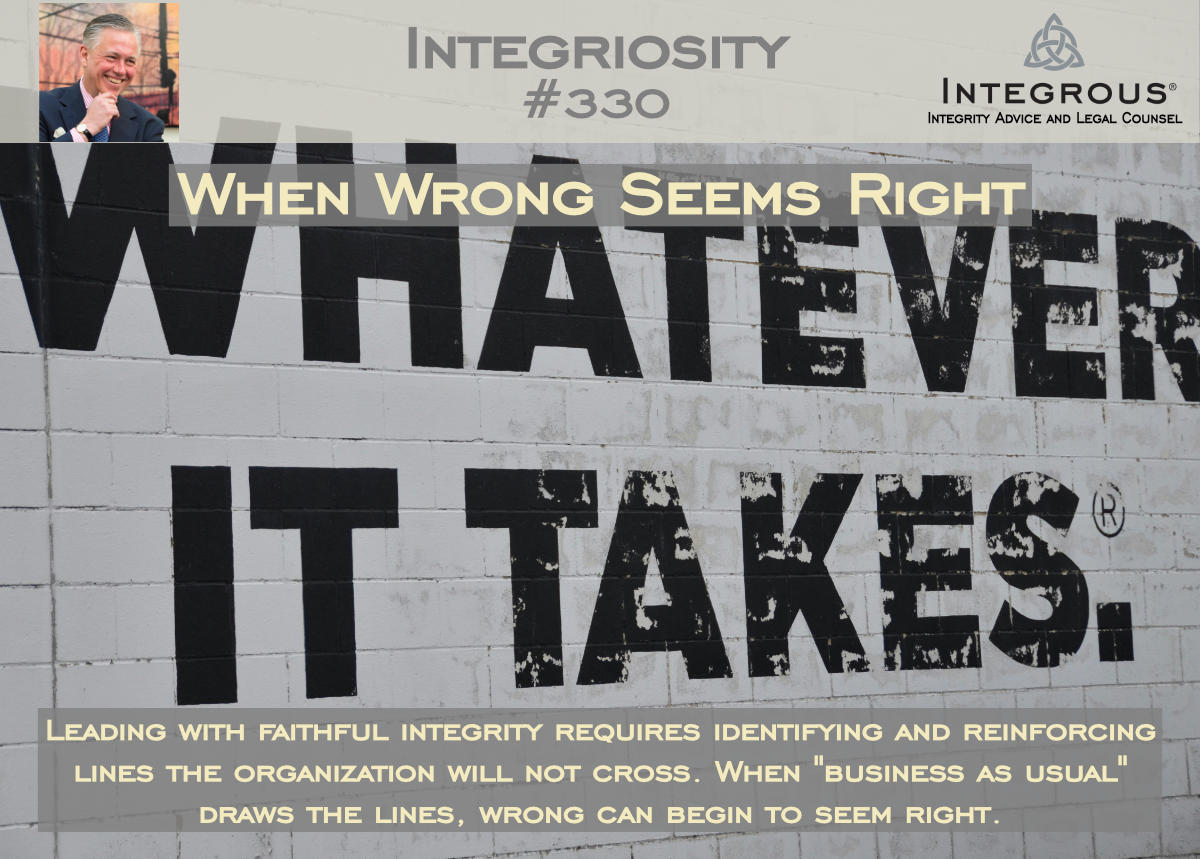
27 May #330 – When Wrong Seems Right
If you don’t follow legal industry news, you probably missed a recent and rather extraordinary court order involving a very prominent law firm. It was extraordinary because it detailed how the culture of an organization can blind people to the point that they convince themselves something clearly wrong seems right.
United States District Court Judge Edward Chen previously awarded nearly $3,000,000 in compensatory sanctions after finding that lawyers for one party had knowingly misled the court. In a recent order, Judge Chen decided how that sanction would be apportioned.
The result was that the compensatory sanction would be borne by the law firm, with several individual lawyers required to pay portions of it personally. The court also imposed a $100,000 punitive sanction and required the firm to develop and administer eight hours of ethics training for the lawyers involved..
The court’s recent order indicates that the associate involved didn’t believe that she did anything wrong.
The purpose of this post is not to shame, judge or expose the law firm involved or its lawyers. It is to use this real-life situation to emphasize the power of a business as usual culture to shape hearts, minds, and behavior of humans made in the image of God.
The Case
The case is Guardant Health, Inc. v. Natera, Inc. (Case No. 21-cv-04062-EMC), and the sanctioned law firm is Quinn Emanuel Urquhart & Sullivan, LLP. Quinn Emanuel represents Natera, a maker of cancer tests, which has been sued by a competitor, Guardant, for false and misleading advertising.
Quinn Emanuel is a respected and highly regarded firm with over 1,300 lawyers in 33 offices in 12 countries around the world. It says it is the third most profitable law firm in the world by profits per equity partner. Its website includes a quote from the Wall Street Journal as to the firm’s reputation:
A global force in business litigation. (The Wall Street Journal)
After ordering the sanctions, the court appointed a Special Master to investigate Quinn Emanuel’s behavior in order to determine culpability. The court’s description of the Special Master’s findings captures the nature of the sanctioned behavior:
His thorough investigation revealed not the misstatement or inadvertence of a single attorney but a pattern of conduct that infected an entire litigation team, from mid-level associate to managing partner.
At virtually every juncture in this misadventure, these attorneys turned a blind eye to the truth, deliberately failed to exercise diligence, violated their duties of candor to the Court, and then attempted to justify it–without basis.
In telling the story of what occurred in the form of a “Professional Ethics issue spotter,” the judge noted:
In strategy discussions, the team agrees on the party line: nobody misled the Court.
The associate tells herself that thin distinctions are what lawyering is all about.
In the end, the Court finds that the associate and her firm deliberately and knowingly misled the Court. When asked about it later, the associate doesn’t believe that she did anything wrong.
The Culture
We have talked a lot about culture in prior blogs. Culture in an organization is “how we do things around here”—how people behave, how people treat other people, how people are motivated, what people perceive to be valued, what behavior is tolerated, encouraged or discouraged, which policies and rules are followed and which are ignored.
It is an ever-changing reality that must be cultivated and curated. It is growing and evolving even if management does nothing about it—in fact, it grows and evolves BECAUSE management does nothing about it.
More than lofty purpose statements and value lists, the culture of an organization reflects its true heart—the WHY and HOW behind everything it does. If the WHY and HOW reflected in the culture does not match well with the WHY and HOW on the website, the website probably has it wrong.
Unlike most law firms, Quinn Emanuel took the time to describe its culture on its website, including a page headed “Our Philosophy.” The firm philosophy has eight principles, but it is the first two that are most telling for the purposes of trying to understand the Guardant case.
The first listed principle: We Play to WIN. Litigation is a zero sum game. There are winners and losers. We play to win.
The second listed principle: We Play FAIR. Ethics are ingrained into our culture. We play by the rules—period. Winning the right way is the only way.
It is worth noting that the “Our Philosophy” page appears as a subpage under “Careers.” In other words, it is not merely public relations copy; it is part of what the firm tells potential new lawyers about “how we do things around here.”
Scanning the rest of the Quinn Emanuel website, the first principle of “winning” is the only one to appear prominently outside the Careers section:
The homepage includes, “We don’t just fight. We Win.”
On the page titled “About Quinn Emanuel”, “LITIGATION IS A ZERO SUM GAME. There is a winner and a loser. WE KNOW HOW TO WIN.”
A culture of not only winning but winning aggressively is communicated through the quotes the firm highlights in describing itself:
Law firm most feared globally by large businesses. (BTI Consulting Group Survey)
Better. Faster. Tougher. Scarier. (The American Lawyer)
Perhaps most telling is how the culture described on Quinn Emanuel’s website played out in real-life in the Guardant case. As described by Judge Chen (emphasis added):
Though each attorney culpable bears individual responsibility for their actions, their conduct implicates a culture of lawyering that is deeply disturbing. It is a culture that takes refuge in lawyering finesse and prioritizes winning motions over acting ethically. This kind of lawyering multiplies proceedings, balloons costs, and erodes trust in counsel. It is not good for anyone: not for the Court, not for the client, and not for the attorneys involved, on either side. It is particularly damaging to younger associates, who take their cues and learn their practice from partners who fail to model ethical behavior, creating a vicious cycle.
The associate doesn't believe that she did anything wrong. (Judge Edward M. Chen)
The Conflict
One of the passages of Scripture we quote most often is Matthew 6:24—”No one can serve two masters.” For Quinn Emanuel, the two masters on its website were “WIN” and “FAIR.” Those two masters are only compatible until they aren’t—until being fair might result in losing. The firm’s website risks sending a message about which of those two masters will matter most when they come into conflict.
As we described in post #221 (Integrity Idea 050: Discourage Winning), business as usual prioritizes winning. We devoted post #169 to describing The “Way” of the World and focused on four key attributes of the “way” of business as usual that are at odds with the “way” of God’s Kingdom:
• Profit as Purpose
• A Scarcity Assumption
• A Self-Interest Assumption
• A “Can We” Culture
When these work together, organizations and people operate out of fear and use fear to manage others, which leads to manipulative and dehumanizing “survival” practices in order to “win”. Because an organization manages to its purpose, a key role of the organizational culture of the business will be to drive profit. “Winning” becomes maximizing the bottom line.
The Scarcity Assumption means everything is a zero-sum situation (my gain is your loss and vice versa). Combined with a Can We Culture in which ethics or the law are seen as the only boundaries (or even obstacles) in the pursuit of the organization’s purpose, competition (whether internal or external) to “win” and a fear of “losing” can lead to pushing (or even crossing) boundaries.
Quinn Emanuel’s website described its business as a “zero sum game.” It touted the firm’s leading profitability. Judge Chen’s description of the behavior of the firm’s lawyers feels like a Can We Culture that crossed both the lines of ethics and the law. They even seemed to cross those lines believing it was “what lawyering is all about.”
That is the danger of a culture in which “Can we?” slowly crowds out “Should we?” Once winning becomes the practical plumb line, the boundary line can begin to look less like a line and more like an obstacle.
These behaviors are certainly not in alignment with the Biblical principles such as faithful stewardship, love, generosity, mutuality, flourishing and Shalom.
The Cure
We are confident that Quinn Emanuel was not trying to tell its lawyers that crossing ethical and legal boundaries is acceptable if that is the cost of winning, but its website clearly sets a cultural tone that winning is the priority. The behavior of the firm’s lawyers in the Guardant case suggests a culture that at least tolerated if not encouraged pushing those boundaries.
The cure for this kind of cultural drift is not better slogans. It is a realignment and constant reinforcement of purpose, values, practices, and boundaries. It is identifying, establishing and communicating the lines the organization will never cross, no matter the cost.
Our post on “Discourage Winning” is not written for a litigation law firm—it was written for leaders of organizations generally. Clients hire litigators to win, but lawyers have a professional responsibility to put Quinn Emanuel’s second principle first.
Post #210 (Integrity Idea 040: Set Integrity Boundaries) was about faithful leaders identifying, establishing and communicating the integrity lines the organization will not cross in how it operates, no matter the cost. Quinn Emanuel said it—”We play by the rules—period“—but it does not appear to be the master people believed they were ultimately to serve.
Leading with faithful integrity calls for a “should we” rather than a “can we” culture. A “should we” culture in an organization flows from a commitment by faithful leaders to lead the organization in pursuing a “WHY” that is bigger than maximizing profit, to live out a set of values that reflect and reinforce that purpose, and to pursue that purpose by doing the right thing, in the right way, for the right reasons and by supporting all workers in doing the same.
For a litigation firm, that does not mean caring less about excellence, advocacy, or winning for clients. It means making clear that advocacy must always be bounded by truth, candor, and professional responsibility. More broadly, for any organization, it means making clear that mission, values, and integrity are not decorative words for the website; they are the standards by which success will be judged.
It requires prayerful discernment by faithful leaders committed to identifying all the ways in which their organization and its employees are at risk of drifting from its mission or sacrificing its values. These risks are unique to each organization.
It also requires an honest assessment of the organization’s “real culture” to identify behavior, practices and expectations that may lead employees to take actions antithetical to the organization’s purpose and values. We devoted an entire post to this topic (Integrity Idea 014: Understand Your “Real Culture”).
Way back in post #039 (Keep First Things First) we explained Integriosity® and said the key Biblical principles forming the foundation of Integriosity are embedded in the word itself–Integrity (and its components Righteousness and Kingdom) and Generosity (and its components Love and Humility). They are the priorities faithful leaders need to “keep first”.
Where the organization’s Re-Imagined Values serve as a plumbline to keep the organization heading in the right direction, integrity boundaries serve as guardrails to keep it from inadvertently running into a ditch.
The real-time moment of someone’s line-crossing decision is likely to be influenced by factors such as emotion, fear of failure, a desire to “succeed”, time-pressure, and worldly-pressure–all of which can push a person toward an action that undermines the faithful purpose and values of the organization. Having a boundary defined before that moment will help the person stay on the right side of the line, particularly when they trust that the organization’s leaders will support the decision even if it is costly to the organization.
Ultimately, leading with faithful integrity requires identifying, establishing and communicating the righteousness and Kingdom lines the organization will never cross, no matter the cost—even if it were to mean losing a case, losing a client or the demise of the organization.
When those lines are not clear, culture will draw its own. And when business as usual draws the lines, wrong can begin to seem right.
PERSONAL NOTE (from PM): I saw a mention of this case last week while serving as a mentor for the Christian Legal Society’s Fellows program. They brought 40 law students to DC from around the country for a week focused on learning what it means to integrate Christian faith and legal vocation. I believe any lawyer who professes to be a follower of Jesus needs to be a member of CLS. They do wonderful work supporting attorneys and law students, fighting to protect religious liberty, and facilitating legal aid for those in need.
ESSENCE: If you don’t follow legal industry news, you probably missed a recent and rather extraordinary court order that sanctioned a prominent law firm and detailed how the culture of an organization can blind people to the point that they convince themselves something clearly wrong seems right. The purpose of this post is not to shame, judge, or expose the law firm involved or its lawyers. Rather, it uses this real-life situation to illustrate the power of a business as usual culture to shape hearts, minds, and behavior of humans made in the image of God. Unlike most law firms, the sanctioned firm took the time to describe its culture on its website, including a philosophy of playing to WIN and playing FAIR. Matthew 6:24 makes clear that no one can serve two masters, and those two masters are only compatible until they aren’t—until being fair might result in losing. Once winning becomes the practical plumb line, the boundary line of fairness can begin to look less like a line and more like an obstacle. The behavior of the firm’s lawyers suggests how a culture can at least tolerate, if not encourage, pushing that boundary. Leading with faithful integrity requires an honest assessment of the organization’s “real culture” to identify behavior, practices and expectations that may lead employees to take actions antithetical to the organization’s purpose and values. It also requires identifying, establishing and communicating the lines the organization will never cross, no matter the cost. When those lines are not clear, culture will draw its own. And when business as usual draws the lines, wrong can begin to seem right.
Copyright © 2026 Integrous LLC. Integriosity is a registered Service Mark of Integrous LLC.
Photo Credit: Original image by Roger Starnes Sr on Unsplash
(photo cropped)
Sorry, the comment form is closed at this time.