
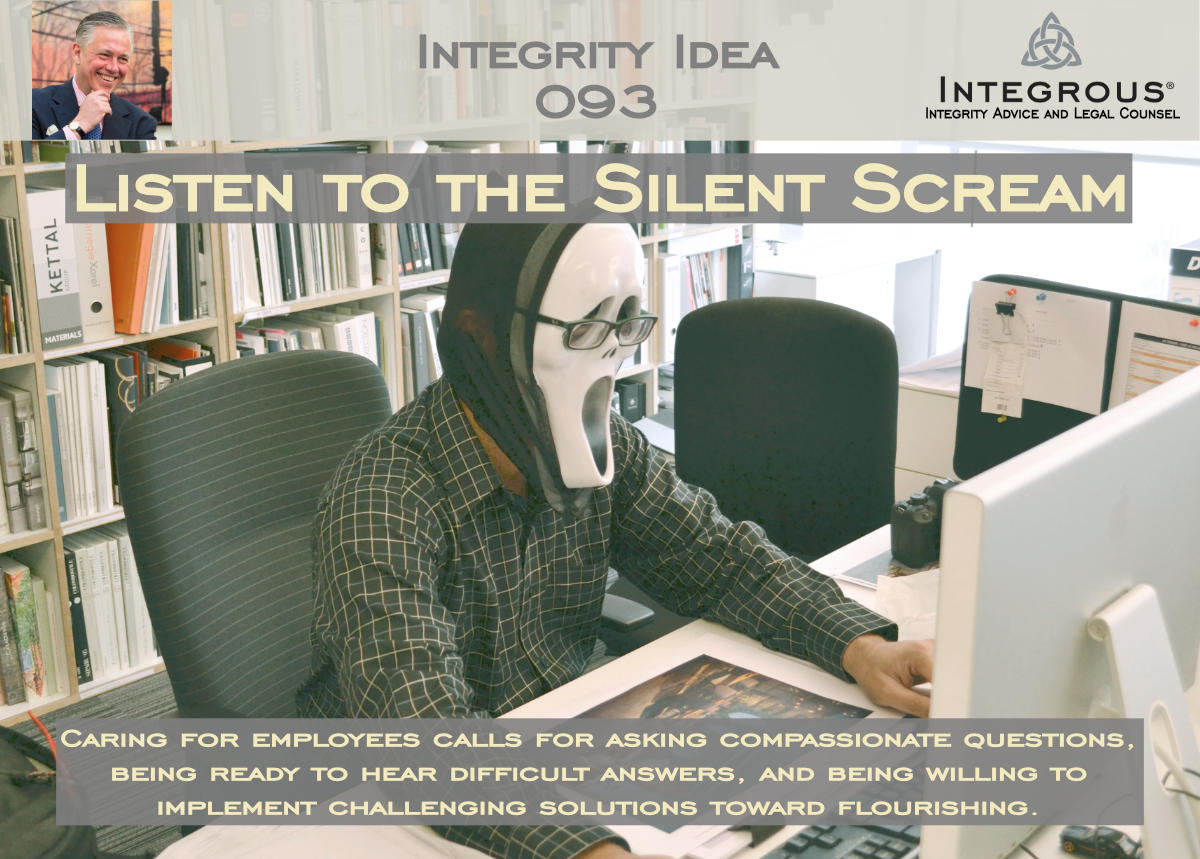
21 Jan #312 – Integrity Idea 093: Listen to the Silent Screams
Integrity Ideas are specific actions a leader can consider during the Re-Align step of Integriosity®–actions that will begin to Re-Align the organization with Biblical beliefs, principles and priorities. You can find more Integrity Ideas at Integrous | Integrity Ideas (integriosity.com)
INTEGRITY IDEA: Listen to the Silent Screams
“Listen to the Silent Screams” is about a faithful leader putting in place practices to understand how employees really feel about their work and their jobs.
Integrity Ideas are practical actions toward implementing a bigger WHY for the organization. We believe some are critical (and necessary) steps in the RENEW/RE-ALIGN/RE-IMAGINE/RESTORE process. Others are just ideas to be considered if they feel like a good fit based on what leaders prayerfully discern is best for stewarding the organization toward its WHY.
“Listen to the Silent Screams” is in the “critical” category. It recognizes that faithfully stewarding an organization includes faithfully stewarding the people who make up the organization, and that stewardship of people made in the image of God requires a culture that facilitates people becoming more “fully human” through their work. Proverbs 27:23 instructs:
Know well the condition of your flocks, and give attention to your herds.
At a time when hashtags like “Great Resignation”, “Quiet Quitting”, “Great Detachment”, “Quiet Cutting”, “Job Hugging” and “Resenteeism” have filled social media, they reflect a deep unease about work rather than a collection of passing trends. At the same time, U.S. employee engagement is down, and employee well-being is in decline.
It marks a time when a faithful leader leading with faithful integrity through business a better way toward Biblical flourishing should prayerfully and courageously consider an honest assessment of employee engagement and flourishing, as well as an honest assessment of the organization’s “real” culture.
We have considered some of these hashtag phenomena in past posts. For example, we called the “Great Resignation” the “Great De-Humanization” in post #120 and we asked whether “Quiet Quitting” was “unhuman” in post #136. Post #254 recast the “Great Detachment” as the “Great Reattachment Opportunity” and post #260 considered the “heartless hustle” of “Quiet Cutting”. “Job Hugging” and “Resenteeism” seem to flow from the “Great Detachment”–people hating their jobs but staying out of fear. Justin Angsuwat, chief people officer at Culture Amp, is quoted in a Fast Company article as saying:
Fear drains people. Purpose fuels them . . .. The goal is to make sure employees stay for the right reasons.
People hating their work and staying out of fear is definitely not God’s design. God meant work as a blessing–a way to express our Imago Dei and love others by using our God-given productivity and creativity to serve others. Business as usual has turned into a burden. The hashtags suggest people are silently “screaming”. To borrow an old saying, “Houston, we have a problem!” Gallup reports:
• Employee wellbeing has been on a decline.
• Employees feel more detached from their employers.
• Employee engagement has reverted to its lowest level in a decade.
Detached and discontent workers are not experiencing the fullness of humanity God intended. This is not merely an organizational problem; it is a theological one. To truly reflect Imago Dei in our work, we need to take joy in it just as God took joy in His creation. God made us to flourish through work, and we are less fully human when not reflecting our God-given creativity and productivity through work that is fulfilling.
Faithful stewardship has the opportunity—and responsibility—to help restore work as a context for human flourishing
As we have written in the past, employee “engagement” is a helpful proxy for assessing whether work is perceived as a burden or a blessing, and Michael Stallard’s “connection culture” is the best tool we know for understanding human engagement at work in an organization.
Stallard explains that a healthy work culture is a “culture of connection” in which humans feel connected to the organization, to their work and relationally to each other. This aligns with managing an organization in a way that prioritizes relationships, community, human dignity and flourishing–it aligns with business a better way. According to Stallard, a healthy culture of connection exists when people have:
- Vision: When everyone in the organization is motivated by the mission, united by the values, and proud of the reputation.
- Value: When everyone in the organization understands the needs of people, appreciates their positive unique contributions, and helps them achieve their potential.
- Voice: When everyone in the organization seeks the ideas of others, shares their ideas and opinions honestly, and safeguards relational connections.
Creating a culture in which people feel valued and feel that they have a voice requires listening by faithful leaders. We have talked about the importance of listening in other contexts: Post #149 (Integrity Idea 017: Listen to a Life) is about taking the time to listen to the life “story” of a work colleague; Post #185 (Integrity Idea 030: Encourage “Biblical EQ”) is about listening in the context of developing “emotional intelligence” from a Biblical perspective; and post #214 (Integrity Idea 044: Re-Imagine the Box) is about listening to the ideas and wisdom employees have about how the organization operates.
“Listen to the Silent Screams” is about listening to employees’ hearts about their work. It calls for a faithful leader to be willing to ask compassionate questions, be ready to hear difficult answers, and be willing to implement challenging solutions toward flourishing. Again, looking to Proverbs:
Let the wise hear and increase in learning, and the one who understands obtain guidance. (Proverbs 1:5)
A faithful leader listening in that way models Humility, one of the four “first thing” principles embedded in the word Integriosity®. It is the key to understanding the “HOW” of the other three “first things”–Righteousness, Kingdom and Love–and it is a key to Wisdom. Humility is knowing who you are in relation to God’s creation and his plan, knowing who you are in relation to others, and knowing who you are in relation to God. Such an understanding permits leadership in service to a bigger WHY of serving others.
A faithful leader listening in that way also models the recognition of Imago Dei, living out the commandment to love your neighbor, and valuing relationships and flourishing.
A faithful leader listening that way builds a culture of value and voice.
A faithful leader listening that way Humanizes their employees.
As with everything about leading with faithful integrity, that listening must come from the right WHY–the right heart. It can’t be driven by an agenda of higher productivity or lower attrition. It must reflect what was said in the Bible about Mordecai:
For Mordecai . . . was . . . popular with the multitude of his brothers, for he sought the welfare of his people and spoke peace to all his people. (Esther 10:3)
“Listen to the Silent Screams” is caring for fellow humans for the right reasons, which reflects and reinforces a culture that recognizes the Imago Dei in each person, lives out the Golden Rule and the commandment to love your neighbor, and prioritizes relationships, community, human dignity, and flourishing.
CONTINUUM: Practices
The Integriosity model organizes “heart change” along six Covert-Overt Continuums. There is nothing magic about these categories, but we believe they are helpful in thinking about practical execution of a Re-Imagined Purpose, Re-Imagined Values and a Re-Imagined Culture. The Continuums are Prayer, Proclamation, Policies, Practices, Products, People.
Each Continuum represents an area in which leaders can begin to think about, plan and institute Re-Alignment changes to the heart of the organization.
“Listen to the Silent Screams” is on the Practices Continuum. It is a practice the organization can adopt to care for employees and to reflect and reinforce its purpose and values.
COVERT-OVERT RATING: Highly Covert
The Integriosity model breaks the Covert-Overt Continuums into six gradations–from Highly Covert to Highly Overt–that we believe are helpful in beginning to pray and think about what is most appropriate for an organization at a particular moment in time.
Most Integrity Ideas will have one place on the scale. Some can vary depending on how they are implemented. We identify “Listen to the Silent Screams” as Highly Covert (An action that would be taken by a secular company) because every organization could and should strive to ensure that its employees are engaged and flourishing.
“Listen to the Silent Screams” can also be Overt (An overtly faith-based action known generally within the organization) if the leaders of the organization choose to explain its importance in terms of Imago Dei , the Golden Rule, the commandment to love your neighbor, and Biblical basis for the organization prioritizing relationships, community, human dignity, and flourishing.
STAKEHOLDERS SERVED: Employees
When we categorize faith-based actions, we also consider the stakeholders principally impacted by the action: Employees, Customers/Clients, Owners, Suppliers/Vendors, Community and Kingdom.
“Listen to the Silent Screams” principally serves Employees by helping them feel valued and by giving a voice to any frustrations and fears.
Know well the condition of your flocks, and give attention to your herds. (Proverbs 27:23)
IMPLEMENTATION
It is not easy to “Listen to the Silent Screams”. First, hearing something “silent” requires finding ways to have it heard. Second, listening to “screams” means that it is likely to be criticism that is difficult to hear.
Implementing “Listen to the Silent Screams” should start with an honest assessment of the organization’s “real” culture, including assessing what people perceive to be its real purpose, values and culture, the assumptions and motivations that underpin its policies and practices, and the real WHY behind its purpose, values and culture. We explored this in detail in post #237 (Real Culture Revisited).
Understanding an organization’s “real” culture can benefit from third-party assistance. Here are two examples of groups that can help with a cultural assessment:
• Connection Culture Group: We have frequently discussed the work of Michael Stallard and his book Connection Culture: The Competitive Advantage of Shared Identity, Empathy, and Understanding at Work. Stallard’s Connection Culture Group offers an assessment tool they call the Connection Culture Pulse that can be used to assess the culture within organizations and teams. Although the Connection Culture model is grounded in Biblical principles, it is expressed in secular terms.
• Best Christian Workplaces Institute. Back in post #103 (Business As Usual in “Ministry”), we mentioned a of a prominent non-profit (The Gideons International) that recognized it had a toxic culture and took steps to address the problem. One of the steps they took was to engage the Best Christian Workplaces Institute to help them implement a cultural assessment. BCWI offers various assessment tools and services.
Implementing “Listen to the Silent Screams” should include “listening”. Whether or not employees are willing to talk, just being asked with compassion about their work can be a healing step that builds or rebuilds trust and reflects and reinforces a culture that prioritizes relationships, community, human dignity, and flourishing.
A recent Fast Company article titled “Your employees aren’t disengaged. They’re fed up“ suggests some techniques for better intentional listening:
• Ask about feelings and solutions separately.
• Keep it simple
• Be receptive to harsh truths
• Be clear about anonymity
Because employees may be operating out of fear, implementing “Listen to the Silent Screams” would benefit from an anonymous path to voice “screams”, such as a survey or questionnaire. The greater the assurance of anonymity, the higher the likelihood of an honest response.
Finally, implementing “Listen to the Silent Screams” requires courageous action, prayerfully taking steps to bring the real culture back in alignment with Biblical beliefs, principles and priorities. Without action, the “listening” was nothing more than “hearing”. Listening without a willingness to act risks deepening cynicism rather than building trust.
Aligning an organizational culture with Biblical beliefs, principles and priorities and a priority of Biblical flourishing is counter-cultural, and counter-cultural actions by a faithful leader require courage and trust. James Hunter warns:
To enact a vision of human flourishing based in the qualities of life that Jesus modeled will invariably challenge the given structures of the social order. In this light, there is no true leadership without putting at risk one’s time, wealth, reputation, and position.
Leading faithfully through business a better way toward Biblical flourishing in the face of risks and resistance requires faith, and faith requires trust in God’s sovereignty and God’s promises, such as the promise in Matthew 6:33, “But seek first the kingdom of God and his righteousness and all these things will be added to you.”
Faithful leadership listens not to manage people, but to care for them. Caring for people through implementing “Listen to the Silent Screams” is also a step toward transforming an organizational culture.
• Employees who experience being the recipient of “Golden Rule” and “love your neighbor” behavior will be better equipped to deliver “Golden Rule” and “love your neighbor” behavior, both to customers and co-workers.
• Employees treated with dignity and respect as creations in the image of God will be better equipped to live out Imago Dei in their treatment of customers and fellow employees.
• Employees who feel engaged with their work want to do it well and will have a positive attitude about their work, which benefits customers as well as the work atmosphere for other employees.
Faithful leaders operating in an increasingly secular culture and sharing “best practices” and stories of transformation can serve to encourage and equip other faithful leaders in their efforts to lead with faithful integrity. It is not about implementing overt practices but being overt about the practices being implemented and the bigger WHY behind them, wherever they are on the Covert-Overt Continuums.
When a faithful leader boldly proclaims initiatives that their organization has implemented in order to operate with faithful integrity in alignment with Biblical beliefs, principles and priorities, and shares how those initiatives have cultivated an organizational culture that Humanizes People and reattaches detached workers, it is like tossing the proverbial stone into a pond, creating ripples that can change the broader culture.
The ripple-effect of such a courageous action has been described eloquently by Robert Kennedy:
It is from the numberless diverse acts of courage and belief that human history is shaped. Each time a man stands up for an ideal or acts to improve the lot of others or strikes out against injustice, he sends forth a tiny ripple of hope, and crossing each other from a million different centers of energy and daring, those ripples build a current that can sweep down the mightiest walls of oppression and resistance. (Robert Kennedy)
PERSONAL NOTE (from PM): This post was originally inspired by some Fast Company articles about employee engagement and then prompted to action by a conversation this weekend with my nephew. He works for a small manufacturing company in Massachusetts. He told me that the company sends out a monthly anonymous survey to employees. Each month, the topic changes, but every month’s survey ends with the same question that can be tracked over time–“how empowered do you feel at work.” Beyond collecting data, he said that there have been changes made to benefits as a result of survey responses. He thought people felt “heard.” I was more impressed when I checked out their website. The vision statement includes “empowering a team united by opportunity and passion.” Their monthly question is directly tied to their WHY.
ESSENCE: Integrity Ideas are specific practical actions a faithful leader can consider in leading faithfully through business a better way.
INTEGRITY IDEA: Listen to the Silent Screams
“Listen to the Silent Screams” is about a faithful leader putting in place practices to understand how employees really feel about their work and their jobs. At a time when hashtags like “Great Resignation”, “Quiet Quitting”, “Great Detachment”, “Quiet Cutting”, “Job Hugging” and “Resenteeism” have filled social media–and U.S. employee engagement and wellbeing is down–a faithful leader leading with faithful integrity through business a better way toward Biblical flourishing should prayerfully and courageously consider an honest assessment of employee engagement and flourishing, as well as an honest assessment of the organization’s “real” culture. “Listen to the Silent Screams” recognizes that faithfully stewarding an organization includes faithfully stewarding the people who make it up, and that stewardship of people made in the image of God requires a culture that facilitates people becoming more “fully human” through their work. “Listen to the Silent Screams” calls for a faithful leader to ask compassionate questions, be ready to hear difficult answers, and be willing to implement challenging solutions toward flourishing. “Listen to the Silent Screams” is caring for fellow humans for the right reasons–reflecting and reinforcing a culture that recognizes the Imago Dei in each person, lives out the Golden Rule and the commandment to love your neighbor, and prioritizes relationships, community, human dignity, and flourishing.
COVERT-OVERT CONTINUUM (six Continuums for action): Practices
COVERT-OVERT RATING (several levels from Highly Covert to Highly Overt): Highly Covert
STAKEHOLDERS SERVED: Employees
Copyright © 2026 Integrous LLC. Integriosity is a registered Service Mark of Integrous LLC.
Photo credit: Original image by Andri: https://www.pexels.com/photo/person-wearing-scream-mask-and-black-dress-shirt-while-facing-computer-table-during-daytime-218413/ (photo cropped)
No Comments