
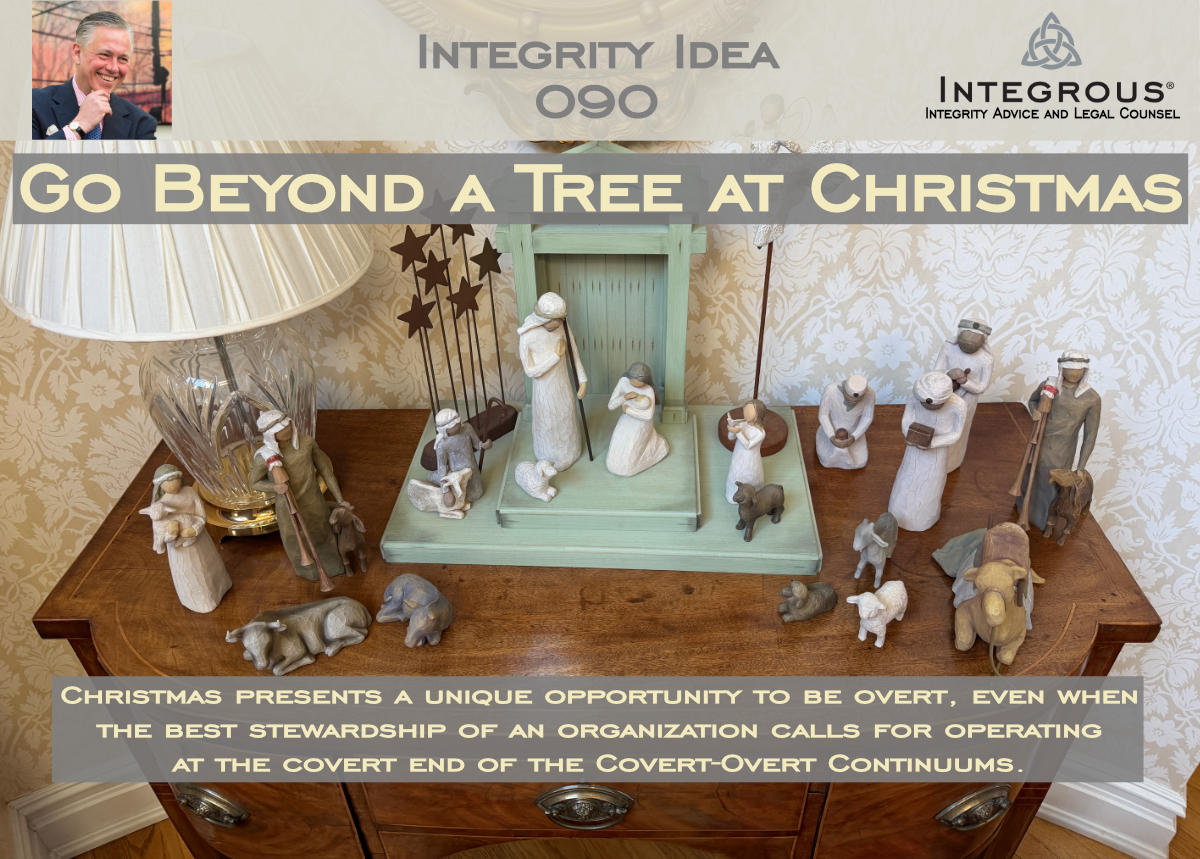
17 Dec #307 – Integrity Idea 090: Go Beyond a Tree at Christmas
Integrity Ideas are specific actions a leader can consider during the Re-Align step of Integriosity®–actions that will begin to Re-Align the organization with Biblical beliefs, principles, and priorities. You can find more Integrity Ideas at Integrous | Integrity Ideas (integriosity.com)
INTEGRITY IDEA: Go Beyond a Tree at Christmas
“Go Beyond a Tree at Christmas” is about faithful leaders displaying tasteful faith-inspired objects, such as a nativity scene creche, in the workplace at Christmas rather than just a Christmas tree. The point is not to reject the Christmas tree, but to recognize that—on its own—it no longer clearly proclaims the meaning of Christmas.
Integrity Ideas are practical actions toward implementing a bigger WHY for the organization. Some are critical steps in the RENEW/RE-ALIGN/RE-IMAGINE/RESTORE process; others are ideas to consider through prayerful discernment as faithful leaders steward the organization toward its WHY.
Because “Go Beyond a Tree at Christmas” is a very overt display of faith, it falls into the “if it fits” category. That said, we believe Christmas presents a unique opportunity to be overt, even when a faithful leader has determined that the best stewardship of the organization calls for operating at the covert end of the Covert/Overt Continuums. It is an easy and inexpensive way to proclaim the faith that informs the leader and the bigger WHY of the organization.
“Go Beyond a Tree at Christmas” recognizes that Christmas is a time when people are generally more open to seeing overt faith-inspired symbols. It is a time when a faithful leader may feel more comfortable pointing employees and customers toward the bigger WHY of the organization–a WHY grounded in Biblical faith. It also recognizes that the Christmas tree has been widely secularized–culturally shared and religiously optional–rather than an explicitly faith-inspired symbol in most public and commercial settings. Putting up a tree says little about the organization’s pursuit of business a better way toward Biblical flourishing.
If you walk the streets of Manhattan, you will see a “Holiday” tree in the lobby of many office buildings. It has become detached from explicit theological meaning and reinterpreted as a neutral cultural symbol. While nativity scenes on government property raise objections and even give rise to lawsuits, the Christmas/Holiday tree rarely offends because it has been neutralized, symbolizing a season of consumption rather than contemplation. T.S. Eliot poignantly observed:
We had the experience but missed the meaning. And approach to the meaning restores the experience in a different form.
Deuteronomy 6:12 warns, “Take care lest you forget the Lord.” So many of today’s Christmas traditions preserve an experience of joy and generosity but have lost the meaning of Christmas.
“Go Beyond a Tree at Christmas” is one way that a faithful leader can introduce an “approach to the meaning” that “restores the experience in a different form“. It can prompt people to begin to remember the meaning. In remembering, the Christmas experience can be restored to something even richer–in the words of Psalm 105:5:
Remember the wondrous works that he has done.
For a faithful leader pursuing faithful integrity through the alignment of the organization’s heart with Biblical beliefs, principles and priorities, “Go Beyond a Tree at Christmas” reinforces the Scriptural basis of that alignment and the importance to that alignment of understanding and living a bigger Gospel–a Gospel that begins in Genesis and goes through to Revelation.
The nativity scene is a reminder of God’s great gift of a Messiah who came into a broken world to bring God’s image-bearers back into relationship with their Creator. Unlike a tree, it is unmistakably a faith-inspired object and could be combined with relevant Bible verses.
A nativity scene tells a Biblical story that points to the second, third and fourth Chapters of the Four-Chapter Gospel–Fall, Redemption and Restoration.
An Advent wreath leading up to Christmas, with the four candles of Hope, Peace, Joy and Love, presents another opportunity to remind people of a bigger Gospel and God’s Restoration plan for his creation. The anticipation of Advent, which means “coming” or “arrival,” begins in Bethlehem, but it ends in Revelation.
• Hope: “a new heaven and a new earth” (Revelation 21:1)–“the holy city, new Jerusalem, coming down out of heaven from God” (Revelation 21:2)
• Peace: the end of death, mourning, and pain (Revelation 21:4) and full restoration of God’s holy order (Revelation 21:27)
• Joy: God wiping away every tear and eliminating crying (Revelation 21:4)
• Love: God dwelling fully with his people (Revelation 21:3)
Many of those office lobbies with Holiday trees also display a menorah in recognition of Hanukkah–to honor the practice of Jewish employees. We think faithful leaders who profess to follow Jesus should consider displaying a menorah if they have any Jewish employees, customers, or vendors.
Those who are followers of Jesus may have never considered displaying a menorah, particularly those who have been raised on a truncated Two-Chapter Gospel. As we explained in post #190 (First Things-Kingdom), a Two-Chapter Gospel basically abridges God’s grand narrative to the middle two Chapters of Fall and Redemption–“You’re a sinner and Jesus came to save you.” For that message, a nativity scene does the trick.
In addition to honoring the Jewish holiday of Hanukkah, a menorah is both reminder of the importance of a Four-Chapter Gospel that begins with the Old Testament and the first Chapter of Creation, and a reminder of the reality that Jesus was a Jewish rabbi who came as the Jewish Messiah to usher in the Kingdom of God and begin the fourth Chapter of Restoration for all creation. The seven candles of the traditional menorah (the Hanukkah menorah has nine candles) are often seen to represent the seven days of creation in Genesis, with the middle candle representing the Sabbath.
When a faithful leader who professes to follow Jesus puts up a menorah, they are opening a door to questions. They are creating an opportunity to talk about the importance of the Old Testament and the Genesis story to understanding Imago Dei, the Creation Mandate and God’s purpose for work and business. They are even opening up an opportunity to talk about the traditional menorah being mentioned in Revelation 4:5 as the “seven torches of fire, which are the seven spirits of God,” and the importance of understanding God’s restoration plan for his creation.
It is important to recognize that the nine-light Hanukkah menorah is very different from the traditional seven-light temple menorah. The temple menorah was designed by God in Exodus 25:31-40. Hanukkah celebrates the rededication of the temple when the Maccabees revolted and reclaimed it from the Greek Empire. The Hanukkah menorah represents a miracle that occurred when rededicating the temple and relighting the temple menorah. A single days’ oil lasted for eight days (with the ninth candle being used to light the others).
Displaying a menorah should never be an attempt to appropriate Jewish faith or somehow draw it into the Christmas message, but an act of respect and an acknowledgment of Christianity’s roots.
Whether or not a Hanukkah menorah is appropriate for a particular organization and its employees, the display of faith-inspired objects to celebrate Christmas glorifies God and opens up opportunities for deeper conversation about the pursuit of faithful integrity through business a better way toward Biblical flourishing.
CONTINUUM: Proclamation
The Integriosity model organizes “heart change” along six Covert-Overt Continuums. There is nothing magic about these categories, but we believe they are helpful in thinking about practical execution of a Re-Imagined Purpose, Re-Imagined Values and a Re-Imagined Culture. The Continuums are Prayer, Proclamation, Policies, Practices, Products, People.
Each Continuum represents an area in which leaders can begin to think about, plan and institute Re-Alignment changes to the heart of the organization.
“Go Beyond a Tree at Christmas” is on the Proclamation Continuum. Proclamation involves actions that share Biblical faith messages with those who may not have a Biblical faith. Although a Christmas tree has largely become a secularized and cultural symbol, the nativity and other unmistakably faith-inspired symbols can point directly to Biblical stories and beliefs.
COVERT-OVERT RATING: Very Overt
The Integriosity model breaks the Covert-Overt Continuums into six gradations–from Highly Covert to Highly Overt–that we believe are helpful in beginning to pray and think about what is most appropriate for an organization at a particular moment in time.
Most Integrity Ideas will have one place on the scale. Some can vary depending on how they are implemented.
“Go Beyond a Tree at Christmas” is Very Overt (an overtly faith-based action involving suppliers, vendors or customers) because it involves displaying unmistakably faith-inspired objects in public areas of an organization where they may be seen not only by employees but also by others coming into the workplace.
STAKEHOLDERS SERVED: Kingdom
When we categorize faith-based actions, we also consider the stakeholders principally impacted by the action: Employees, Customers/Clients, Owners, Suppliers/Vendors, Community and Kingdom.
“Go Beyond a Tree at Christmas” serves the Kingdom by reminding people of the true meaning of Christmas, of Jesus’ role as the Jewish Messiah, of the importance of the Old Testament in understanding God’s purpose for work and for business, and of the importance of Jesus ushering in the Kingdom of God and beginning the fourth Chapter of Restoration for all creation.
We had the experience but missed the meaning. (T.S. Eliot)
IMPLEMENTATION
Some Integrity Ideas are challenging and expensive to implement. Others are easy but costly. Still others are inexpensive but challenging. “Go Beyond a Tree at Christmas” is an easy and inexpensive opportunity to reflect and reinforce a bigger WHY aligned with Biblical beliefs, principles and priorities.
For a faithful leader prayerfully discerning how to implement “Go Beyond a Tree at Christmas”, here are some possibilities to consider:
• A nativity scene creche in a public area.
• Relevant Bible verses posted near the creche or even available for people to take.
• An Advent wreath with the four candles of Hope, Peace, Joy and Love, together with an explanation of the Advent season available for people to take.
• An “angel tree” with gift requests from children who might otherwise not receive anything at Christmas, such as children in foster care.
• A time set aside for employees to sing traditional Christmas Carols that tell the story of Christmas, such as Silent Night and Hark the Herald Angels Sing, or a choir brought in to perform Christmas Carols for employees (in either case, with employee participation or attendance optional).
The display of a Hanukkah menorah should be respectful of, and sensitive to, Jewish tradition. For example, a faithful leader should consider whether the lighting of each candle will be accompanied by traditional prayers and blessings. If so, who will offer those prayers and blessings? Consider involving Jewish employees in the planning.
If done respectfully, displaying a Hanukkah menorah not only honors Jewish employees but can serve as a reminder to followers of Jesus of the importance of a Four-Chapter Gospel that begins with the Old Testament and as a reminder that Jesus was a Jewish rabbi who came as the Messiah to usher in the Kingdom of God and begin the fourth Chapter of Restoration for all creation.
Christmas is an opportunity for a faithful leader to take a step toward the overt end of the Covert-Overt Continuums–an opportunity to share the source of the hope, peace, joy, and love they are committed to cultivating in the organization’s culture. It is an opportunity to help people remember–remember the source of the hope, peace, joy and love they so desperately want to experience when seeing a Christmas tree.
In a culture shaped by thin symbols and thick consumption, even small acts of clear proclamation can quietly re-orient an organization toward truth.
PERSONAL NOTE (from PM): This post was inspired by a walk through Manhattan with my son. Seeing the commercial element of Christmas on full display and noticing the Holiday trees in office lobbies.
I learned a great deal about the menorah in the process of writing this post. For example, I never knew there were two types, and never understood the meaning behind Hanukkah.
We keep a creche in our home all year round–it is the one in the photograph. (We also keep a Christmas tree up and decorated year-round in our Vermont home).
ESSENCE: Integrity Ideas are specific actions a faithful leader can consider in leading faithfully through business a better way.
INTEGRITY IDEA: Go Beyond a Tree at Christmas
“Go Beyond a Tree at Christmas” is about faithful leaders displaying tasteful faith-inspired objects, such as a nativity scene or Advent wreath, in the workplace at Christmas rather than just a Christmas tree. It recognizes that the Christmas has been widely secularized and neutralized, symbolizing a season of consummation rather than contemplation. It also recognizes that Christmas presents a unique opportunity to be more overt with employees and customers about the bigger WHY of the organization–a WHY grounded in Biblical faith–even when a faithful leader has prayerfully discerned that the best stewardship of the organization calls for operating at the covert end of the Covert-Overt Continuums. For a faithful leader pursuing faithful integrity through the alignment of the organization’s heart with Biblical beliefs, principles and priorities, “Go Beyond a Tree at Christmas” reinforces the Scriptural basis of that alignment and the importance to that alignment of understanding and living a bigger Gospel–a Gospel that begins in Genesis and goes through to Revelation. The nativity scene is a reminder of God’s great gift of a Messiah who came to bring God’s image-bearers back into relationship with their Creator. An Advent wreath points us toward the Hope, Peace, Joy, and Love that will come in the final Chapter of the Four-Chapter Gospel–Restoration for all creation. If done respectfully, displaying a Hanukkah menorah not only honors Jewish employees but can serve as another reminder to followers of Jesus of the importance of a bigger Gospel that begins with the Old Testament and as a reminder that Jesus was a Jewish rabbi who came as the Messiah to usher in the Kingdom of God and begin that fourth Chapter of Restoration. Christmas is an opportunity to help people remember–remember the source of the hope, peace, joy and love they so desperately want to experience when seeing a Christmas tree.
COVERT-OVERT CONTINUUM (six Continuums for action): Proclamation
COVERT-OVERT RATING (several levels from Highly Covert to Highly Overt): Very Overt
STAKEHOLDERS SERVED: Kingdom
Copyright © 2025 Integrous LLC. Integriosity is a registered Service Mark of Integrous LLC.
Photo credit: Original image by Paul Michalski (image cropped)
Sorry, the comment form is closed at this time.