
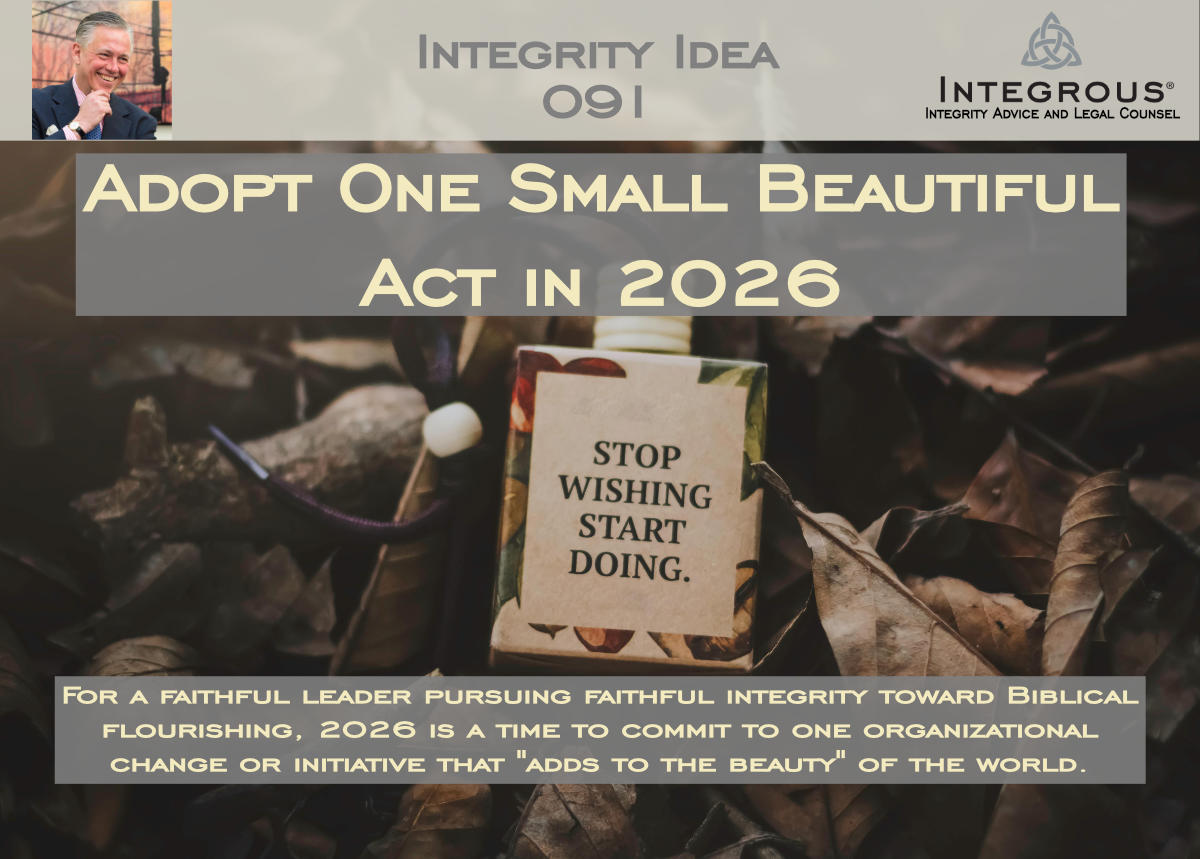
07 Jan #310 – Integrity Idea 091: Adopt One Small Beautiful Act in 2026
Integrity Ideas are specific actions a leader can consider during the Re-Align step of Integriosity®–actions that will begin to Re-Align the organization with Biblical beliefs, principles and priorities. You can find more Integrity Ideas at Integrous | Integrity Ideas (integriosity.com)
INTEGRITY IDEA: Adopt One Small Beautiful Act in 2026
We know what this title might bring to mind, because it was in the news quite a lot in 2025. “Adopt One Small Beautiful Act in 2026” has nothing to do with what you might be thinking (but we must admit this title was inspired by that other title just for fun).
“Adopt One Small Beautiful Act in 2026” is about a faithful leader committing to make one change or take one initiative in their organization in 2026 that “adds to the beauty” of the world. It is not about symbolism, signaling, or scale—it is about movement.
Integrity Ideas are practical actions toward implementing a bigger WHY for the organization. We believe some are critical (and necessary) steps in the RENEW/RE-ALIGN/RE-IMAGINE/RESTORE process. Others are just ideas to be considered if they feel like a good fit based on what leaders prayerfully discern is best for stewarding the organization toward its WHY.
“Adopt One Small Beautiful Act in 2026” is different from other Integrity Ideas, because it is not about a specific action. It is about committing to do something.
As much as we hate the idea of New Year’s resolutions, you can think of it as a New Year’s resolution to begin moving the heart of your organization in the direction of beauty rather than ugliness–moving in the direction of business a better way rather than business as usual–moving in the direction of Biblical flourishing rather than Profit as Purpose. It is less about what you do and more about the decision that you will act.
It is also the start of a new Integrous tradition–a January reminder that “beautiful” doesn’t require “big”. In fact, “big” can be intimidating and lead to inaction–which isn’t “beautiful”.
Why “Adding to the Beauty” Matters
When addressing this topic last January in post #257 (Integrity Idea 067: Plant a Tree in 2025), we pointed to a quote from Nicky Gumbel explaining Revelation 21:1-27:
This passage has within it a paradox concerning the new creation. There will be ‘a new heaven and a new earth’, but Christ says, ‘I make all things new’ (v.5, NKJV) – not, ‘I make all new things’. This is an indication of the continuity with this creation.
So many Integrity Ideas come back to understanding a bigger four-chapter Gospel of God’s Kingdom, not merely a truncated two-chapter Gospel of personal salvation. Without it, we lack a foundation for understanding why “one small, beautiful act” today matters in the biggest scheme of all–eternity.
But adopting “one small, beautiful act” also matters because it is a movement from noble intention to transformative action. A recent Fast Company article titled “In 2026, corporate purpose will come to a fork in the road” suggested that 2026 is a year in which:
The stakes are no longer about having a nice-to-have “purpose platform” but about whether purpose becomes the backbone of the business or disappears completely . . .. Purpose will only be credible when it can withstand scrutiny from investors, regulators, employees, and communities—and when it shapes what a company does and doesn’t do.
Although the Fast Company article comes from a secular perspective and is based on interviews with members of the Purpose Collaborative, it makes an important point–transformation requires commitment and action. In the words of Jordan Belfort from “The Wolf of Wall Street” (whatever one thinks of the source), “Without action, the best intentions in the world are nothing more than that–intentions.”
A faithful leader who makes it through RENEW and RE-IMAGINE but never crosses the bridge to begin RE-ALIGNING will never get to the RESTORE step of Integriosity®. 2026 is a time to put RENEW and RE-IMAGINE into action.
Refresher: Part Four of the Four-Part Gospel
The nature of “a new heaven and a new earth” and what happens to us and our world when Jesus returns may be theologically controversial topics, but they are also important ones. They are important because our understanding of “where we are going someday” profoundly affects “how we act today”.
In the interest of simplifying (not caricaturing serious theology), there are basically two Biblical views of heaven and what happens to earth (we don’t need to get into theological debates regarding: whether there is a hell; if there a hell, who goes there and who goes to heaven; and if there is a hell, whether it is eternal):
Rapture. People going to heaven are whisked off to an ethereal heaven and the earth burns up.
Restoration. Heaven is here on earth in a restored Kingdom that unites God’s dimension with our earthly dimension.
We highly recommend N.T. Wright’s book Surprised by Hope: Rethinking Heaven, the Resurrection, and the Mission of the Church for a discussion of the two views of heaven, their genesis, as well as an explanation of what we actually learn from the Bible. Here are a few excerpts:
Traditionally, of course, we suppose that Christianity teaches about a heaven above, to which the saved or blessed go, and a hell below, for the wicked and impenitent.
It comes as something of a shock, in fact, when people are told what is in fact the case: that there is very little in the Bible about “going to heaven when you die” and not a lot about a postmortem hell either. The medieval pictures of heaven and hell, boosted though not created by Dante’s classic work, have exercised a huge influence on Western Christian imagination.
But the language of heaven in the New Testament doesn’t work that way. “God’s kingdom” in the preaching of Jesus refers not to postmortem destiny, not to our escape from this world into another one, but to God’s sovereign rule coming “on earth as it is in heaven.”
Heaven, in the Bible, is not a future destiny but the other, hidden, dimension of our ordinary life—God’s dimension, if you like. God made heaven and earth; at the last he will remake both and join them together forever.
Artist Makoto Fujimura also captures this idea in his work:
What we build, design, and depict on this side of eternity matters, because in some mysterious way, those creations will become part of the future city of God.
Now, let’s consider how these two views of heaven impact how we act today:
Rapture. If people going to heaven are whisked off to an ethereal heaven and the earth burns up, what we do on earth doesn’t matter much in the long run (assuming you believe in salvation by faith rather than by works)–it is all going away and, ultimately, our efforts to improve the world are in vain. What we do on earth mainly matters to the extent it encourages (or discourages) people to turn toward God or reflects God’s compassion for the underserved (which hopefully also encourages them to turn toward God). “Adopt One Small Beautiful Act in 2026” does not have lasting significance.
Restoration. If heaven is here on earth in a restored Kingdom that unites God’s dimension with our earthly dimension, then things get exciting because what we do here may last into eternity. 1 Corinthians 15:58 tells us “Therefore, my beloved brothers, be steadfast, immovable, always abounding in the work of the Lord, knowing that in the Lord your labor is not in vain.” “Adopt One Small Beautiful Act in 2026” is not in vain.
For a beautiful picture of what the Restoration view means, let us again turn to N.T. Wright, who describes the implications of the Restoration option as follows:
What you do in the present—by painting, preaching, singing, sewing, praying, teaching, building hospitals, digging wells, campaigning for justice, writing poems, caring for the needy, loving your neighbor as yourself—will last into God’s future. These activities are not simply ways of making the present life a little less beastly, a little more bearable, until the day when we leave it behind altogether. They are part of what we may call building for God’s kingdom
“Adding to the beauty” matters. We have the opportunity to beautify the world through the way in which we work and the way in which we conduct business and lead organizations. Every decision has the potential to move God’s Kingdom a little closer to God’s perfect Restoration. Looking again to Makoto Fujimura, as he writes in Art + Faith, “Without beauty and mercy, the gospel will not change the world.”
Why Beauty Matters
Everything we do–particularly every human interaction–can only do one of two things: (1) make the world at least a tiny bit more beautiful, or (2) make the world at least a tiny bit uglier. (Neutrality is a possibility, but missing an opportunity to beautify isn’t beautiful). While outcomes are not always immediately clear, we can still choose the intention and direction of our actions.
“Beautiful” was clearly God’s design when he created everything and declared it “very good”:
And God saw everything that he had made, and behold, it was very good. (Genesis 1:31)
As you read the description of the New Jerusalem that is coming–God’s Kingdom on earth–in Revelation 21:10-11, “beautiful” is the word that comes to mind:
And he carried me away in the Spirit to a great, high mountain, and showed me the holy city Jerusalem coming down out of heaven from God, having the glory of God, its radiance like a most rare jewel, like a jasper, clear as crystal.
In between the beauty of a garden and the beauty of a gleaming city, God blessed us and left us with a command–the “Creation Mandate”:
Be fruitful and multiply and fill the earth and subdue it, and have dominion over the fish of the sea and over the birds of the heavens and over every living thing that moves on the earth. (Genesis 1:28)
God made us in God’s creative, productive and relational image (Imago Dei), gave us a perfectly imperfect world, and then told us to take care of it and make it flourish–make it even more beautiful! We believe it is a call to create with beauty. “Adopt One Small Beautiful Act in 2026” is a call to take a step in the direction of beauty. It is a call captured by a quote we love from Barbara Bush:
And as you go, find a way to make this world more beautiful.
By its very nature, business can add to the beauty of the world by creating solutions to challenges of human life, economic prosperity that makes those solutions affordable and accessible, and jobs that allow people to fulfill their humanity and purpose by using their God-given creativity and productivity to serve others.
With profit as its “end”, business as usual often brings the inherent “beauty-potential” of business (solutions, prosperity and jobs) with an ugly cost to God’s creation, particularly people.
Business a better way is focused on glorifying God by maximizing flourishing of God’s creation–putting creation, particularly people, as the end and profit in its proper place as a means. It is answering the call to create with beauty by stewarding the gift of a business in obedience to the Creation Mandate and the two great commandments and in furtherance of the ultimate purpose of all creation—glorifying God.
CONTINUUM: Prayer, Proclamation, Policies, Practices, Products, People
The Integriosity model organizes “heart change” along six Covert-Overt Continuums. There is nothing magic about these categories, but we believe they are helpful in thinking about practical execution of a Re-Imagined Purpose, Re-Imagined Values and a Re-Imagined Culture. The Continuums are Prayer, Proclamation, Policies, Practices, Products, People.
Each Continuum represents an area in which leaders can begin to think about, plan and institute Re-Alignment changes to the heart of the organization.
“Adopt One Small Beautiful Act in 2026” could be on any Continuum. It is about committing to do something on one of them.
COVERT-OVERT RATING: Highly Covert to Highly Overt
The Integriosity model breaks the Covert-Overt Continuums into six gradations–from Highly Covert to Highly Overt–that we believe are helpful in beginning to pray and think about what is most appropriate for an organization at a particular moment in time.
Most Integrity Ideas will have one place on the scale. Some can vary depending on how they are implemented. “Adopt One Small Beautiful Act in 2026” could be anywhere along the Continuums from Highly Covert (An action that would be taken by a secular company) to Highly Overt (an overtly faith-based action involving community, website, sales/marketing materials).
STAKEHOLDERS SERVED: Employees, Customers/Clients, Owners, Suppliers/Vendors, Community, Kingdom
When we categorize faith-based actions, we also consider the stakeholders principally impacted by the action: Employees, Customers/Clients, Owners, Suppliers/Vendors, Community and Kingdom.
“Adopt One Small Beautiful Act in 2026” might serve any one or more of the stakeholders.
Without beauty and mercy, the gospel will not change the world. (Makoto Fujimura)
IMPLEMENTATION
Implementation of Integrity Ideas is often the longest section of a post. This time, it is the shortest. Just do something that moves your organization in the direction of beauty–in the direction of operating with faithful integrity through business a better way toward Biblical flourishing. A fruit of pursuing faithful integrity through business a better way toward Biblical flourishing is to partner with God in his restoration project for his Kingdom.
We believe God’s restoration project is a beautification project, and by pursuing Biblical priorities of relationship, community, human dignity and the flourishing of people and communities, an organization and the collection of people it represents can “add to the beauty” of the world–bringing it a bit closer to God’s design and plan.
If you have not undertaken the first step of Integriosity®, perhaps your “small beautiful act” can be going through a RENEW process. If so, contact us.
If you recognize that your integration of faith and business has been detoured down a faith as usual Side Road, take one step toward transforming the heart–the WHY–of the organization.
If the RENEW step is complete, then choose any of the 90 Integrity Ideas we have offered (you can find links to the first 86 in post #301 (The Path to Here: 300 Markers). Some are overt, some are covert, and many can be either. Some require meaningful work and investment, while others are fairly simple and inexpensive.
Pick one and “Adopt One Small Beautiful Act in 2026”. We believe that first step will inspire you to adopt many more–a “big, beautiful” RE-ALIGNMENT that Humanizes People, Beautifies the World and Glorifies God.
Wishing you a more beautiful 2026.
PERSONAL NOTE (from PM): It can be overwhelming to think about how to RE-ALIGN the Purpose, Values and Culture of an organization to align with Biblical beliefs, principles and priorities. If I ever wake up in the middle of the night in a cold sweat, it is probably because I was having a nightmare about how Lisa and I will get rid of everything in our basement when we eventually decide to downsize–25 years of accumulation! In the light of day, I know that it has to be one box or one item at a time. Likewise, when a faithful leader is thinking about RE-ALIGNING the culture of their organization, my recommendation is to identify no more than three beautiful actions to implement–and then take it “one small beautiful act” at a time.
ESSENCE: Integrity Ideas are specific practical actions a faithful leader can consider in leading faithfully through business a better way.
INTEGRITY IDEA: Adopt One Small Beautiful Act in 2026
“Adopt One Small Beautiful Act in 2026” has nothing to do with what you might be thinking. It is the start of a new Integrous tradition–a January reminder that “beautiful” doesn’t require “big”. In fact, “big” can be intimidating and lead to inaction–which isn’t “beautiful”. “Adopt One Small Beautiful Act in 2026” is about a faithful leader committing to make one change or take one initiative in their organization in 2026 that “adds to the beauty” of the world. One of the bigger WHY’s of an organization aligned with Biblical beliefs, principles and priorities is Beautifying the World. A fruit of pursuing faithful integrity through business a better way toward Biblical flourishing is to partner with God in his restoration project for his Kingdom. We believe God’s restoration project is a beautification project, and by pursuing Biblical priorities of relationship, community, human dignity and the flourishing of people and communities, an organization and the collection of people it represents can “add to the beauty” of the world–bringing it a bit closer to God’s design and plan.
COVERT-OVERT CONTINUUM (six Continuums for action): Prayer, Proclamation, Policies, Practices, Products, People
COVERT-OVERT RATING (several levels from Highly Covert to Highly Overt): Highly Covert to Highly Overt
STAKEHOLDERS SERVED: Employees, Customers/Clients, Owners, Suppliers/Vendors, Community, Kingdom
Copyright © 2026 Integrous LLC. Integriosity is a registered Service Mark of Integrous LLC.
Photo credit: Original image by Ihsan Adityawarman: https://www.pexels.com/photo/multicolored-bontainer-2045600/(photo cropped)
No Comments