
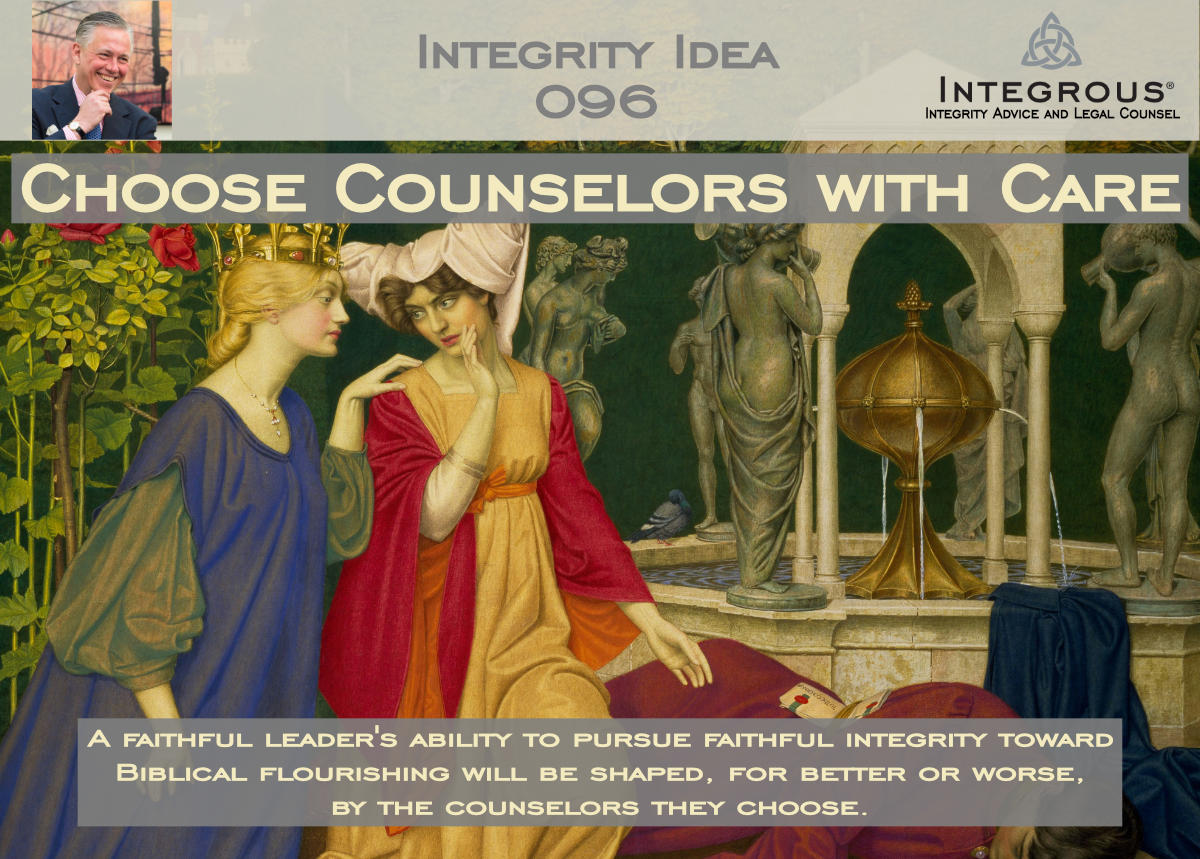
04 Mar #318 – Integrity Idea 096: Choose Counselors with Care
Integrity Ideas are specific actions a leader can consider during the Re-Align step of Integriosity®–actions that will begin to Re-Align the organization with Biblical beliefs, principles and priorities. You can find more Integrity Ideas at Integrous | Integrity Ideas (integriosity.com)
INTEGRITY IDEA: Choose Counselors with Care
“Choose Counselors with Care” is about ensuring that a faithful leader is getting advice and counsel from people who have the wisdom to offer sound judgment, the integrity to give disinterested guidance, the courage to speak hard truth, and the values-alignment to offer prudent direction.
Integrity Ideas are practical actions toward implementing a bigger WHY for the organization. We believe some are critical (and necessary) steps in the RENEW/RE-ALIGN/RE-IMAGINE/RESTORE process. Others are just ideas to be considered if they feel like a good fit based on what leaders prayerfully discern is best for stewarding the organization toward its WHY.
“Choose Counselors with Care” is in the “necessary” category. Every leader receives counsel. The only question is whether that counsel reinforces conviction or erodes it.
Counselors in the Bible
Seeking and receiving counsel is certainly a Biblical principle and priority:
Where there is no guidance, a people falls, but in an abundance of counselors there is safety. (Proverbs 11:14)
The way of a fool is right in his own eyes, but a wise man listens to advice. (Proverbs 12:15)
Without counsel plans fail, but with advisors they succeed. (Proverbs 15:22)
In abundance of counselors there is victory. (Proverbs 24:6)
While plans can fail without counsel, they can also go awry with bad counsel, even if it comes from “many advisors.” Psalm 1:1 warns, “Blessed is the man who walks not in the counsel of the wicked.”
Scripture repeatedly shows kings who failed not because they lacked advisors, but because they embraced bad advice, rejected unpopular counsel, or surrounded themselves with voices that told them what they wanted to hear. The issue was discernment—knowing which voice to trust and having the humility to heed it.
Bad Advice. In 2 Chronicles 22, we read about King Ahaziah. We are told:
He also walked in the ways of the house of Ahab, for his mother was his counselor in doing wickedly. He did what was evil in the sight of the Lord, as the house of Ahab had done. For after the death of his father they were his counselors, to his undoing.
2 Chronicles 24 tells us that King Joash started well under the wise counsel of Jehoiada–he “did what was right in the eyes of the Lord all the days of Jehoiada the priest.” But after Jehoiada died, Joash began to listen to bad advice:
Now after the death of Jehoiada the princes of Judah came and paid homage to the king. Then the king listened to them. And they abandoned the house of the Lord, the God of their fathers, and served the Asherim and the idols.
Rejection of Good Advice. In 1 Kings 12 we learn about King Rehoboam’s ill-fated rejection of wise counsel from Solomon’s old advisors in favor of the poor counsel from the young friends with whom he grew up.
Then King Rehoboam took counsel with the old men, who had stood before Solomon his father while he was yet alive . . .. But he abandoned the counsel that the old men gave him and took counsel with the young men who had grown up with him and stood before him.
Rehoboam’s poor choice of counsel led to the division of the Kingdom.
King Absalom chose the advice of Hushai over the “good counsel of Ahithophel” when deciding how to pursue King David. Hushai’s advice to delay and then go after David himself likely appealed to Absalom’s pride and won out over Ahithophel’s counsel to immediately send troops. Absalom also didn’t know that Hushai was not disinterested–Hushai secretly sent a warning to David based upon the counsel Absalom had received.
Only Wanting Favorable Advice. When King Jehoshaphat and the King of Israel were planning a campaign together, the King of Israel gathered 400 prophets for counsel. All 400 were united in advising them to go forward. Jehoshaphat then asked whether there was any other prophet to consult. The King of Israel replied:
There is yet one man by whom we may inquire of the Lord, Micaiah the son of Imlah; but I hate him, for he never prophesies good concerning me, but always evil.
Micaiah provided the type of wise, disinterested and courageous counsel a faithful leader should seek. Even when he was warned to agree with the 400, he refused.
And the messenger who went to summon Micaiah said to him, “Behold, the words of the prophets with one accord are favorable to the king. Let your word be like the word of one of them, and speak favorably.” But Micaiah said, “As the Lord lives, what my God says, that I will speak.”
Counselors Today
In modern organizations, the dynamic is subtler but no less real. Faithful leaders face moments when the pressure to perform, close the deal, win the dispute or hit the number pushes hard against their values. It can be difficult for a leader embroiled in the emotion, conflict, excitement or anxiety of a situation to step back and intentionally factor Biblical values and priorities into decisions.
Elizabeth Moyer observes:
Without a doubt, stress of all kinds affects our ability to make sound, wise decisions. It can distort our reality, hasten our decision, amplify our foolishness, or paralyze us . . .. When I feel under the attack of stress, my perspective gets clouded, I get overly emotional, and I struggle to see the end goal. Seeking the opinion and perspective of someone I trust and respect brings light to the situation, helps me understand the problem, and can even clarify a solution. Asking for help or counsel when you’re overwhelmed doesn’t always come easy. It takes humility, discernment, and courage. Bringing in an outside opinion can help weigh the costs and benefits of a decision and illuminate a different, helpful perspective.
For a faithful leader aligning their organization’s mission, values and culture with Biblical beliefs, principles, and priorities, it is not enough to choose advisors skilled and experienced enough to offer wise judgment in the way of the world.
Even the most skilled and experienced professionals—lawyers, financial advisors, consultants—may not fully understand the organization’s mission, values and culture, may not share the leader’s Biblical convictions, may have a financial interest in the outcome, or may hesitate to deliver unwelcome advice.
Advisors who do not share the organization’s or leader’s Biblical values and priorities are unlikely to factor those values and priorities into their advice on how to proceed in a situation (such as a transaction or dispute). Advisors whose fees are dependent on the path taken in a situation (e.g., litigate/settle a dispute, pursue/abandon a transaction) are structurally biased, despite the best ethics and intentions.
A faithful leader’s ability to honor their faith conviction and remain on an ancient path of business a better way—and to pursue faithful integrity toward Biblical flourishing—will be shaped, for better or worse, by the counselors they choose. Wise and excellent advice in the way of the world may be antithetical to the best path in the way of God’s Kingdom.
CONTINUUM: Practices
The Integriosity model organizes “heart change” along six Covert-Overt Continuums. There is nothing magic about these categories, but we believe they are helpful in thinking about practical execution of a Re-Imagined Purpose, Re-Imagined Values and a Re-Imagined Culture. The Continuums are Prayer, Proclamation, Policies, Practices, Products, People.
Each Continuum represents an area in which leaders can begin to think about, plan and institute Re-Alignment changes to the heart of the organization.
“Choose Counselors with Care” is on the Practices Continuum. It is a practice a faithful leader can adopt to help ensure that they remain on an ancient path of business a better way and that the organization continues to pursue faithful integrity through business a better way toward Biblical flourishing. Following advice that steers the leader to compromise the organization’s values or erode its culture–whether knowingly or unwittingly–will send a message to other stakeholders about the leader’s and the organization’s real priorities.
COVERT-OVERT RATING: Highly Covert
The Integriosity model breaks the Covert-Overt Continuums into six gradations–from Highly Covert to Highly Overt–that we believe are helpful in beginning to pray and think about what is most appropriate for an organization at a particular moment in time.
Most Integrity Ideas will have one place on the scale. Some can vary depending on how they are implemented. We identify “Choose Counselors with Care” as Highly Covert (An action that would be taken by a secular company) because even the leader of a secular organization should want wise, disinterested, courageous, and prudent advice.
“Choose Counselors with Care” can be moved toward the Overt end of the Continuum by explaining the Biblical foundation for choosing certain advisors over others that the world might hold in higher regard.
STAKEHOLDERS SERVED: Employees, Owners
When we categorize faith-based actions, we also consider the stakeholders principally impacted by the action: Employees, Customers/Clients, Owners, Suppliers/Vendors, Community and Kingdom.
“Choose Counselors with Care” principally serves Employees and Owners by helping leaders ensure that their convictions and the organization’s mission, values and culture are reinforced rather than eroded by the decisions they make.
`{`T`}`hey were his counselors, to his undoing. (2 Chronicles 22:4)
IMPLEMENTATION
There is no magic formula for implementing “Choose Counselors with Care”. A faithful leader committing to making the best decisions for their organization needs to ensure that, whether internally or externally, they are receiving advice and counsel from people who have:
The wisdom to offer sound judgment.
The integrity to give disinterested guidance.
The courage to speak hard truth.
The values-alignment to offer prudent direction.
In an unbroken world, a leader could find advisors who meet all of these requirements, but we live in a broken world. It may be necessary to bring together a team capable of ensuring that a leader is getting, in aggregate, wise, disinterested and prudent truth.
For example, because investment bankers and financial advisors typically charge fees based on the success of a transaction, they are not disinterested in the outcome. Finding a banker or advisor willing to work for a fixed fee might require sacrificing skill or paying a fixed price that would be poor stewardship. A faithful leader should recognize this weakness and ensure they are tempering the advice with values-aligned, disinterested advice.
Likewise, lawyers engaged in a dispute are not disinterested in whether it settles quickly or results in protracted litigation. A faithful leader should recognize this weakness and ensure they are tempering the advice of those lawyers with values-aligned, disinterested advice.
It may be difficult to find the most experienced advisor (e.g., lawyers, consultants, financial advisors) in a particular area of expertise who share the leader’s Biblical values. Finding a values-aligned lawyer or consultant might require sacrificing expertise that would be poor stewardship. A faithful leader should recognize this weakness and ensure they are tempering the advice of the advisor with values-aligned advice from a counselor who can understand the advice and guide the leader in reconciling it with their faith and the mission, values, and culture of the organization.
In an organization pursuing faithful integrity through business a better way, those structural and alignment gaps can often be filled through advice from values-aligned internal advisors, such as a general counsel, ethics officer, or culture coordinator. A leader may recognize that internal advisors, however loyal, lack the personal conviction, positional freedom, or courage to speak hard truth. In that case, supplementing internal advice with trusted external counsel may be the wisest and most faithful path forward.
Thankfully, there are resources to help a leader identify advisors who do share a Biblical faith.
• The Christian Legal Society publishes an online directory of its members, including practice areas.
• Kingdom Advisors publishes an online directory of financial advisors, accountants, insurance brokers, and attorneys who have been through its certification program.
Although these resources can be a helpful start, a faithful leader must resist the assumption that shared belief automatically produces values-aligned advice. Shared faith identity is not the same as shared faith worldview.
A professional may sincerely profess faith, attend church, and affirm orthodox doctrine, but that does not automatically mean they share the leader’s conviction that work and business are sacred and that business should have a bigger WHY than maximizing profit. It does not mean they are equipped to recommend a course of action that sacrifices speed, margin, or advantage for the sake of faithful integrity and the prioritization of flourishing. They may be stuck behind the Sacred/Secular Gap or even the Sunday/Monday Gap.
Scripture’s cautionary tales about kings and counselors are not ancient curiosities; they are enduring leadership lessons. Rehoboam did not lack advisors. Ahab did not lack prophets. What they lacked was the humility to heed faithful counsel and the discernment to recognize voices shaped more by influence, advantage, or popularity than by truth.
Faithful leaders today face quieter but equally consequential choices. The advisors who sit at the table, help shape the strategy, and frame the options will influence whether pressure produces compromise or conviction. Choosing counselors with care is a safeguard for the soul of a leader and the soul of the organization entrusted to them.
Who in your advisory circle is responsible not merely for helping you succeed, but for helping you remain faithful?
PERSONAL NOTE (from PM): This could be seen as the most self-serving of my Integriosity blog posts, but it is a topic too important to ignore. Integrous was conceived specifically to fill two gaps I perceived.
People sometimes hear about Integrous and assume it is executive coaching. While coaching has great value, Integrous was conceived to serve a different role: Integrity Counsel. Integrity Counsel is the provision of disinterested, values-aligned advisory judgment and legal insight in moments when decisions carry moral, cultural, and strategic weight.
One gap is the need for a trusted advisor to walk alongside a faithful leader who is convicted to transform the heart of the organization into alignment with God’s purpose for work and business.
I also perceived a second gap. Even leaders who understand God’s greater purpose for business and are committed to managing their organization according to Biblical beliefs, principles, and priorities can struggle when facing decisions, transactions, disputes, or delicate interactions that place pressure on purpose, values, and culture. In those moments, they benefit from the counsel of a trusted and disinterested advisor who is values-aligned, has the training and experience to understand the situation being faced, and is focused on helping the leader discern the course of action most consistent with faithful integrity.
Integrity Counsel is not conventional legal advice. Because Integrous does not seek to “do the deal” or “fight the battle,” it is structurally disinterested in the outcome and can serve as a values-aligned lens rather than a transactional advocate, helping a leader discern what path or response is most consistent with the Biblical beliefs, principles, and priorities of the organization and the leader.
ESSENCE: Integrity Ideas are specific practical actions a faithful leader can consider in leading faithfully through business a better way.
INTEGRITY IDEA: Choose Counselors with Care
Every leader receives counsel. The only question is whether that counsel reinforces conviction or erodes it. “Choose Counselors with Care” is about ensuring that a faithful leader is getting advice and counsel from people who have the wisdom to offer sound judgment, the integrity to give disinterested guidance, the courage to speak hard truth, and the values-alignment to offer prudent direction. Scripture repeatedly shows kings who failed not because they lacked advisors, but because they embraced bad advice, rejected unpopular counsel, or surrounded themselves with voices that told them what they wanted to hear. In modern organizations, the dynamic is subtler but no less real. Faithful leaders face moments when the pressure to perform, close the deal, win the dispute or hit the number pushes hard against their values. Even the most skilled professionals—lawyers, financial advisors, consultants—may not fully understand the organization’s mission, values and culture, may not share the leader’s Biblical convictions, may have a financial interest in the outcome, or may hesitate to deliver unwelcome advice. A faithful leader’s ability to remain on an ancient path of business a better way—and to pursue faithful integrity toward Biblical flourishing—will be shaped, for better or worse, by the counselors they choose.
COVERT-OVERT CONTINUUM (six Continuums for action): Practices
COVERT-OVERT RATING (several levels from Highly Covert to Highly Overt): Highly Covert
STAKEHOLDERS SERVED: Employees, Owners
Copyright © 2026 Integrous LLC. Integriosity is a registered Service Mark of Integrous LLC.
Photo credit: Original image by Photo by Birmingham Museums Trust on Unsplash (photo cropped)
No Comments