
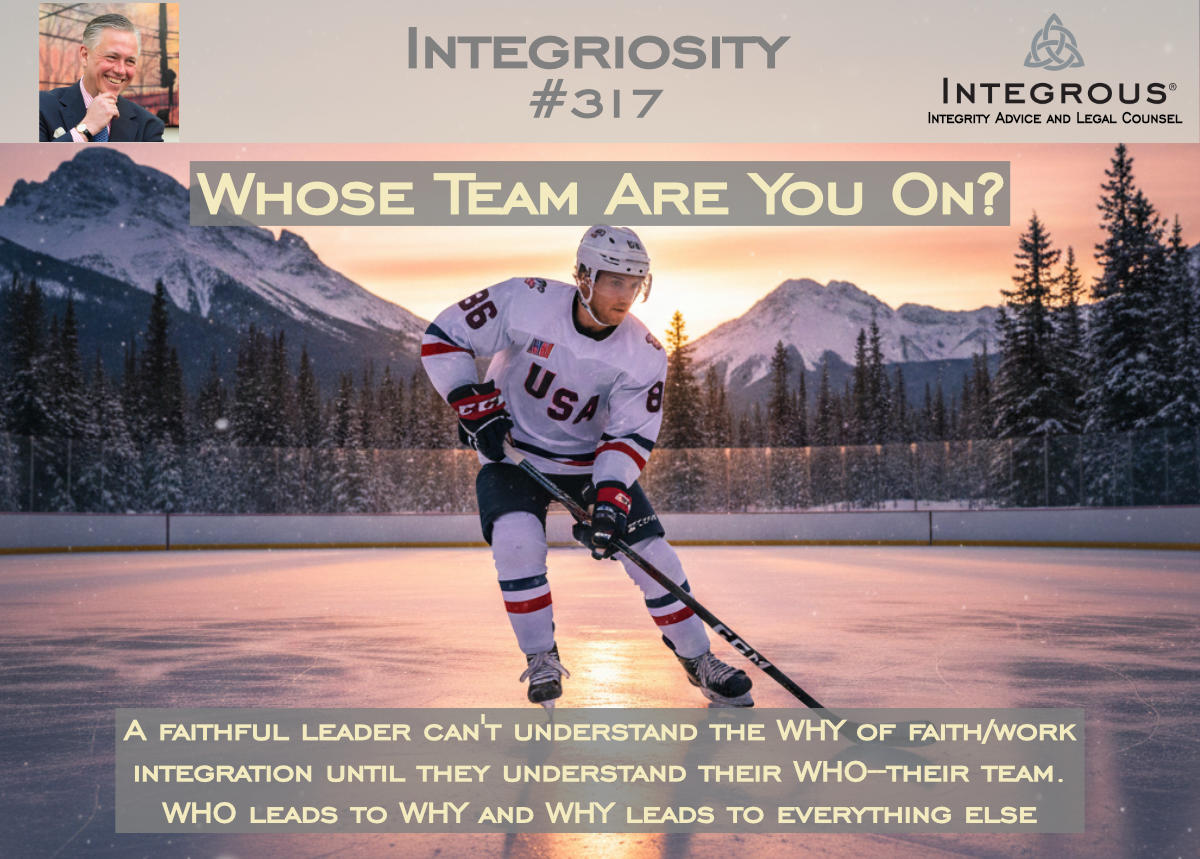
25 Feb #317 – Whose Team Are You On?
For any patriotic American, this past Sunday was an exciting day watching the United States men’s hockey team win a gold medal–the first in 46 years.
Although he may play for the New Jersey Devils in his regular career, Jack Hughes, the player who scored the winning goal, made clear that on Sunday he was playing for Team USA. As reported in the Wall Street Journal, Hughes said:
This is all about our country now. I love the USA. I love my teammates. It’s unbelievable. The USA hockey brotherhood is so strong . . . I’m so proud to be American today.
Jack knew whose team he was on Sunday–USA’s. That identity allowed him to put aside rivalries with other NHL players on Team USA and see his teammates as part of the “USA hockey brotherhood”. It gave him a bigger WHY–representing and glorifying the country he loves.
For a faithful leader, the path to a bigger WHY that aligns with God’s purpose for work and business requires knowing whose team you are on–it requires the right WHO identity.
The Importance of the Right WHO
After watching Sunday’s game, it was difficult not to think back to the “Miracle on Ice” of 1980 and not to watch (or rewatch) the 2004 movie Miracle with Kurt Russell playing Herb Brooks, coach of the 1980 USA hockey team.
One memorable scene represents the turning point for the team. Throughout the beginning of the film, Brooks would ask his players who they were, and each time they would identify themselves by the college for which they played. Following a tie with Norway in an exhibition match, Brooks kept them on the ice running drills until one player stopped and identified himself as playing for Team USA. Brooks immediately ended the drills and released them. Nothing changed but everything changed.
We believe Brooks knew the importance of his players understanding their WHO–whose team they were on–so that they could have a bigger WHY. It was a WHY that could transcend the smaller WHYs that kept them from playing as one. It was a WHY bigger than “winning a hockey game.” It was a WHY that unified them–the same WHY that Jack Hughes expressed.
The importance of WHO in sports also came through in a Wall Street Journal article about Scottie Scheffler.
Scheffler is better at golf than anyone on the planet, but he was wrestling with the meaning—or meaninglessness—of it all. “Why do I want to win the Open Championship so badly?” Scheffler asked the assembled press, channeling Socrates. “I don’t know, because, if I win, it’s going to be awesome for two minutes.” At another point, he said: “This isn’t a fulfilling life.” “It’s fulfilling from the sense of accomplishment,” Scheffler elaborated. “But it’s not fulfilling from a sense of the deepest places in your heart.”
Scheffler could not find a bigger WHY in winning because “golfer” isn’t his primary WHO. It is certainly one of his identities, but it isn’t his primary identity. The article goes on to explain that Scheffler describes his priorities as faith, family and golf, in that order.
He’s been candid about his spirituality and home life, how he prioritizes his faith and family over his profession . . .. “Golf is third in that order,” he said. “Golf isn’t how I identify myself. I don’t identify myself by winning tournaments, chasing trophies, being famous, or whatever it is.”
Each is an identity, but each identity represents a different team. Being a Christian is a team. Being a spouse is a team. Being a parent is a team. Being a golfer or lawyer or doctor or businessperson or welder or hockey player is a team.
But the Bible is clear that a person can only have one team that is their primary team–one identity that is their primary identity (“No one can serve two masters,” Matthew 6:24). A person will sacrifice their secondary identities to succeed at their primary identity. For Jack Hughes, Team USA became a more primary WHO than a New Jersey Devils player during the Olympics. For the players in 1980, Team USA became a more primary WHO than their colleges. For Scottie Scheffler, “faith” is his primary team.
We have devoted several posts to the importance of a faithful leader to have a primary identity based on being a follower of Jesus rather than on what they do as an organizational leader. Here are a few:
Mind-Shift #2–The “WHO” of Leaders (#068)
Commitment to WHO Identity (#087)
Words That Shape Identity (#115)
What’s Your Noun? (#144)
We wrote way back in post #005 that you can’t understand the WHY or HOW of faith/work integration until you understand WHO you are. Your WHO determines your WHY–and your WHY determines everything else.
This is all about our country now. I love the USA. I love my teammates.. (Jack Hughes)
The Importance of the Right WHY
Scottie Scheffler’s quote points to the importance of pursuing the right WHY. The wrong WHY does not lead to a “fulfilling life.” A WHY fails to be fulfilling if it is not God’s WHY–not God’s design.
On the other hand, the right WHY changes everything. Comedian Michael Jr. illustrates this truth in a powerful video (you can watch it below). In it, he asks a member of the audience to sing a few bars of Amazing Grace. He then asks him to sing it “as if your uncle just got out of jail, you got shot in the back when you was a kid–I’m just sayin’ let me see the hood version.” The man’s rendition is remarkably different. Same song and same singer, but the WHY transformed the performance.
The same is true in business. The tasks may look identical, but when the WHY aligns with God’s design, everything changes.
As we have detailed in many posts, we believe that an organization pursuing a WHY divorced from God’s design for work and business will leave its employees unfulfilled in their work lives, because it will leave them less human. Dr. Skip Moen writes:
If I am going to become human, I must move in the direction of the divine design in me. . . I can move toward God’s design innately implanted in me, or I can move away from His design, forging a self-made creature fashioned by lesser purpose
We know from Genesis 2:15 that God designed people to work, from Genesis 2:5 that God created the world to need our work in order to flourish, and from Genesis 1:28 (the Creation Mandate) that God calls and commands humans to steward God’s creation to flourishing.
Business as usual with its focus on Profit as Purpose is not God’s design for work or business.
The Right WHO Leads to the Right WHY
If a faithful leader’s WHO–their priority team–is rooted in their identity as a follower of Jesus rather than in WHAT they do–in other words, if they see themselves as a follower of Jesus engaged in business rather than a businessperson trying to do business in a Christian way–that identity will lead to a WHY aligned with God’s purpose for work and business.
But a faithful leader will find themselves on one of three “teams”, depending on how far they have gotten in crossing the four Gaps of faith/work integration: the Sunday/Monday Gap, the Sacred/Secular Gap, the Knowing/Doing Gap and the Safety/Surrender Gap.
The World Team
The secular “world” view of faith and occupation is that they have absolutely nothing to do with each other (unless the occupation is in “ministry”). A person’s “faith identity” is personal and does not belong at the office/factory/store (sometimes because the proponents of this view are hostile to faith). A person on the World’s Team believes someone who professes a Christian faith should be a Christian on Sundays and a businessperson Monday-Friday. Business is business as usual and the end is Profit as Purpose.
Sadly, many people who profess faith in God do not get much further than this view. The “world” is effectively stuck behind the Sunday/Monday Gap, but so are many regular church-goers. What they do Monday-Friday is disconnected from the faith they practice on Sunday (or Saturday)–not because they are hostile to faith, but because they have never been taught otherwise. This could also be called the Business as Usual Team.
The Faith as Usual Team
Once a faithful leader gets across the Sunday/Monday Gap, there is a good chance they will find themselves on the faith as usual team. They will be encouraged to bring their faith to work and see themselves as a “Christian businessperson”, which is the most frequent “identity” urged by those promoting faith/work integration.
As the faithful leader tries to figure out what it means to bring their faith to work, they may find themselves side-tracked on one or more of the faith as usual Side Roads of Agonizing, Individualizing, Monetizing, Cosmeticizing, Monastecizing, Prosperitizing or Interimizing as they try to live out being a “Christian businessperson”.
Unfortunately, even a faithful leader who crosses the Sacred/Secular Gap can find themselves on the faith as usual team. The faith as usual options look good, feel good and do good without requiring the more difficult and countercultural task of changing the heart of the organization.
Because the words “Christian businessperson” put the primary identity in the noun of “businessperson” and a secondary identity in the adjective “Christian,” success at business will take priority over deeper faith/work integration. The good works of faith as usual can comfortably co-exist alongside business as usual and Profit as Purpose.
At Integrous, we believe a person should NEVER strive to be a Christian businessperson (or Christian hockey player or Christian golfer). Jesus needs to be a faithful leader’s noun, not their adjective.
The Flourishing Team
This could also be called the Business a Better Way Team. As we explained in post #200 (Prioritize Biblical Flourishing), our belief is that the bigger WHY of an organization aligned with Biblical beliefs, principles and priorities should be to maximize flourishing (rather than profit) by Humanizing People, Beautifying the World and Glorifying God, properly positioning profit as a necessary means to that end.
This requires changing the heart of the organization in a deeply countercultural way. James Hunter warns: “To enact a vision of human flourishing based in the qualities of life that Jesus modeled will invariably challenge the given structures of the social order. In this light, there is no true leadership without putting at risk one’s time, wealth, reputation, and position.”
Biblical flourishing flows from the Creation Mandate, Imago Dei, and the commandments to love God and love our neighbor. The call to prioritize Biblical flourishing is also shaped by the Biblical ideas that humans were given unique gifts for the purpose of serving others and humans were created for the purpose of glorifying God.
It is a plumb line that leads to the ultimate WHY hard-wired into every human–to glorify God:
So, whether you eat or drink, or whatever you do, do all to the glory of God. (1 Corinthians 10:31)
Humans glorify their creator God through work by:
• Being (and helping others to be) all that God created them to be–fully human through living out Imago Dei as reflections of a creative, productive and relational God.
• Obediently pursuing the Creation Mandate in Genesis 1:28 (be fruitful and subdue the earth) toward the flourishing (Shalom) of God’s creation.
• Living out the Golden Rule and the two great commandments as they work and using their gifts to love their neighbor generously through the creation and provision of goods and services that people need.
A faithful leader’s pursuit of faithful integrity through business a better way toward Biblical flourishing begins with a primary identity as a follower of Jesus–being a member of the Flourishing Team.
Why Your Team Matters
In his book The 7 Habits of Highly Effective People, Stephen Covey talks about climbing a ladder that is against the wrong wall:
It’s incredibly easy to get caught up in . . . climbing the ladder of success only to discover it’s leaning against the wrong wall.
For a faithful leader, the same can be said of finding yourself on the wrong team.
The World Team
If you lean your ladder on the wall of the World Team, you are likely to find that the success you achieve feels empty. Like Scottie Scheffler, years of hard work may lead to two minutes of euphoria.
Or it may feel like the scene from Chariots of Fire in which Harold Abrahams wins an Olympic gold medal and is seen quietly packing up in the locker room while his teammates celebrate. In urging a teammate not to bother him, one of them says, “Now, one of these days, Monty, you’re going to win yourself, and it’s pretty difficult to swallow.”
Actor Jim Carrey expressed similar feelings of emptiness when the dreams pursued and the success achieved are those defined by the kingdom of the world rather than the Kingdom of God. Carrey once said:
[T]hat you can still be unhappy is a shock when you have accomplished everything you ever dreamt of and more and then you realize, “My gosh, it’s not about this.” And I wish for everyone to be able to accomplish those things so they can see that.
Success achieved on the wrong team cannot fill what was designed to be filled by the right WHO.
The Faith as Usual Team
When a faithful leader leans their ladder on the wall of the Faith as Usual Team, they will likely be engaging in unquestionably good faith activities, and they are likely to receive positive feedback or even be celebrated by the faith/work community. They may even have crossed the Sacred/Secular Gap.
It is easy to become satisfied with the “be good, do good, look good and feel good” comfort of the faith as usual Placebos on the Safety side of the Safety/Surrender Gap. It is easier than transforming the heart of the organization, but it comes at a price. In the words of Ed Silvoso in his book Ekklesia:
The enemy of the “best” . . . . is the “good”, because by being so satisfying, it deprives us of the hunger for the “much more” that in this case God has in store.
The problem is that the Faith as Usual Team can look faithful while still having a WHY of Profit as Purpose. We devoted post #179 (The Misses of “Faith as Usual”) to the “misses” of being on the Faith as Usual Team, which include missed purpose for the organization, missed calling for its leaders, and missed flourishing of its people.
The Flourishing Team
We believe the faithful leader who leans his ladder on the wall of the Flourishing Team and does the hard work of transforming the heart of the organization–its WHY–will be most aligned with God’s purpose for work and business. The pursuit of faithful integrity through business a better way toward Biblical flourishing will lead to crossing the Safety/Surrender Gap.
That Gap is crossed when a faithful leader has fully surrendered their organizational leadership to God, accepting their role as stewards rather than owners. Oswald Chambers declared in My Utmost for His Highest, “There is only one thing God wants of us, and that is our unconditional surrender.”
The team you choose determines the wall against which your leadership ladder will lean. And the wall you choose will determine whether your success feels like two minutes of euphoria . . . or eternal significance.
Whose team are you on?
PERSONAL NOTE (from PM): I spent 39 years–from age 8 to 47–with my ladder leaning against the wrong walls. When I was eight years old, I knew that I wanted to be a lawyer. I don’t know why, as I was the first in my immediate family to go to college, and we didn’t know any lawyers. (Perhaps it was too much Perry Mason.) I also knew at eight that I wanted to go to Harvard College and then Harvard Law School. I didn’t know why except that I had heard or read that they were “the best”. At 15 years old, I decided that I wanted to work for Cravath, Swaine & Moore in New York City after graduating from Harvard Law School based upon a magazine article about the best law firms in America.
All those dreams were realized at the age of 32. I remember sitting in my new partner’s office for the first time, at a big desk with a big leather chair. As I sat down and looked across the room, I thought “That’s it? Is this it? My entire life since eight years old has been focused on sitting in this chair. It should feel more satisfying.” The moment felt disturbingly empty. I had no more career goals.
Thankfully, after 34 years leaning against the wall of the World Team, God woke me up at 42. I spent the next five years trying to figure out how to lean it against the wall of the Faith as Usual Team, and at 47 God told me to pick it up and move it again.
He was not asking me to change professions. He was asking me to change teams. The question was no longer “What do you want to achieve?” but “Whose are you?”
And until I answered that question correctly, every ladder would lean against the wrong wall.
ESSENCE: For any patriotic American, this past Sunday was an exciting day watching the United States men’s hockey team win a gold medal–the first in 46 years. When Jack Hughes set aside NHL rivalries to play for Team USA, he showed the power of knowing whose team you are on. A faithful leader can’t understand the WHY or HOW of faith/work integration until they understand their WHO–the team they are truly on. Each of us carries multiple identities, and each identity represents a different team. But Scripture is clear that only one can be primary. Your WHO determines your WHY–and your WHY determines everything else. For a faithful leader, a WHO rooted in being a follower of Jesus—rather than in what they do—leads to a WHY aligned with God’s purpose for work and business. Every faithful leader will find themselves on one of three teams: the World Team, the Faith as Usual Team or the Flourishing Team. The question is not whether you are climbing, but which wall your ladder is leaning against.
Copyright © 2026 Integrous LLC. Integriosity is a registered Service Mark of Integrous LLC.
Photo Credit: Original image in The Lyda Hill Texas Collection of Photographs in Carol M. Highsmith’s America Project, Library of Congress, Prints and Photographs Division.
(photo cropped)
Sorry, the comment form is closed at this time.